Top Producers vs. Top Performers: Why the Difference Matters in Sales
“What if your ‘top producer’ isn’t your best performer?
And what if promoting them could hurt your team?”
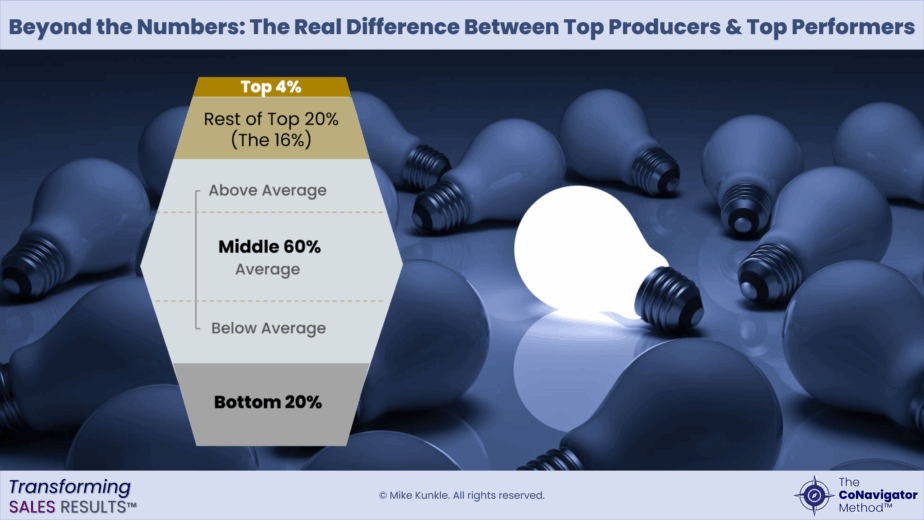
In this article, I reveal the critical differences between top sales producers and top sales performers. Top-performer analysis reveals what truly drives consistent success — empowering leaders like you to hire smarter, train and coach more effectively, and move the needle on the metrics that matter most.
Let’s begin with two quick stories that illustrate a critical point about top sales performance.
Story 1: Matt in Toledo Looked Great—Until He Didn’t
Back in the early 2000s, I conducted a Top Performer Analysis (TPA) for an up-and-coming Wall Street darling whose growth had plateaued. TPA compares sales reps across performance tiers to uncover what truly sets the best apart. As part of the process, I asked regional leaders to categorize their salespeople into top performers (first quintile), average performers (third quintile), and bottom performers (fifth quintile).
One salesperson flagged as a top performer was Matt from Toledo (names and locations have been changed throughout for privacy). His numbers were 40% above average, and his new regional VP was eager for me to include him in the study. But when I dug deeper, I discovered Matt had inherited a very high-performing territory from Sandy, a rep who had left the company six months ago. Sandy’s territory was running at 120% above average when Matt took over. Now it was 40% above average. Six months later (in the future), I learned Matt was underperforming and eventually let go. I didn’t know that at the time but based on the precipitous fall from 120% above average down to 40%, I probably could have predicted it.
Had I included Matt in the study (which I didn’t), I might have mistakenly promoted his methods as best practices—an error that could have misled future training efforts and hurt the performance of others. Thankfully, I didn’t.
Story 2: Laura in Nashville Was a Hidden Gem
Laura had just joined the company and was tasked with launching our presence in Nashville. She’d only been on board for four months when I began my analysis. Her performance was 30% below average, but she was building a territory from scratch. Her growth trajectory was steep—far beyond expectations for a new market. “Top New Performers” is a category I look for and try to include in my TPA work, especially if they shot out of onboarding like a rocket. Which Laura did.
Though her VP hadn’t flagged her as a top performer, I included her in the study. Six months later, Laura had climbed into the top quintile. She was exactly the kind of rep we should be hiring more often.
These examples highlight a critical truth: numbers alone don’t tell the whole story.
Circumstantial Success vs. True Capability
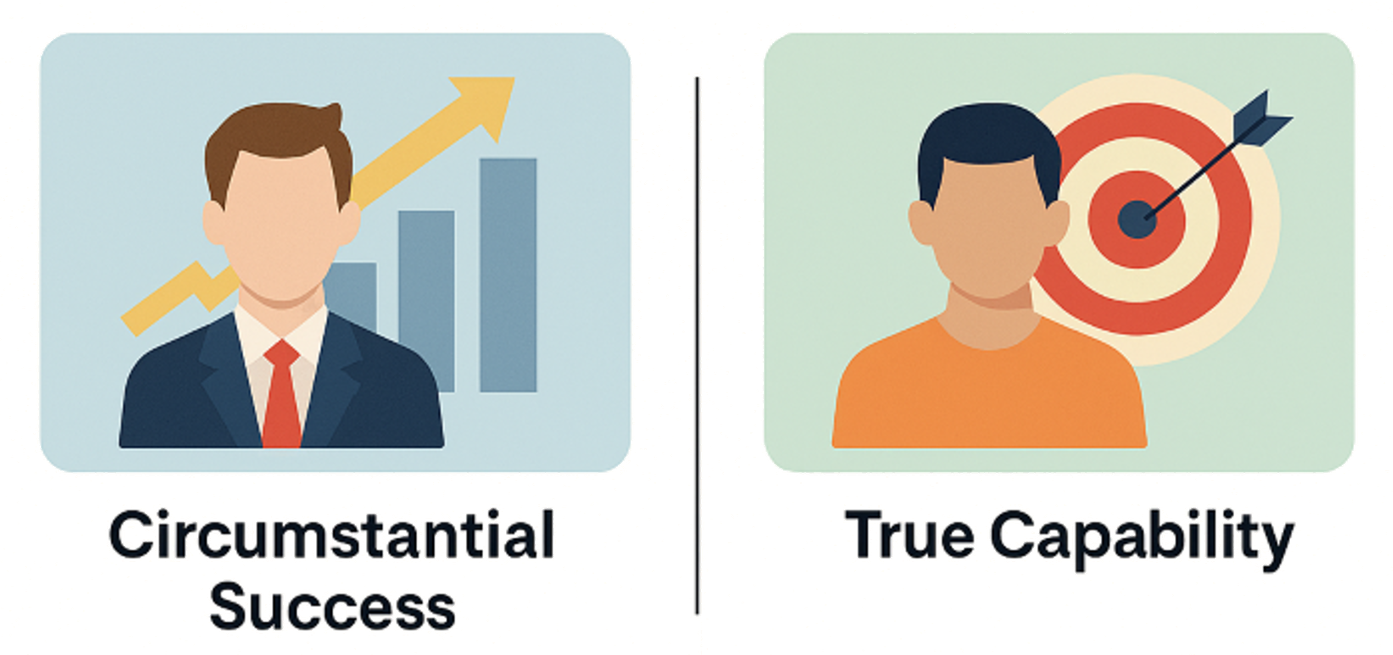
These stories underscore a key insight: being a top producer at a single point in time doesn’t necessarily mean someone is a top performer. Some reps benefit from favorable circumstances, while others with high potential are held back by external factors.
A top performer in a tough territory will still outperform an average rep in the same conditions—but even they have limits. Interestingly, research from Objective Management Group shows that true top performers tend to take ownership of their results, regardless of external challenges. But that doesn’t mean the external factors don’t play a role in dampening their full potential. It’s important to recognize that market conditions, product limitations, and internal support structures do influence outcomes.
What Makes a “Circumstantial Top Producer?”
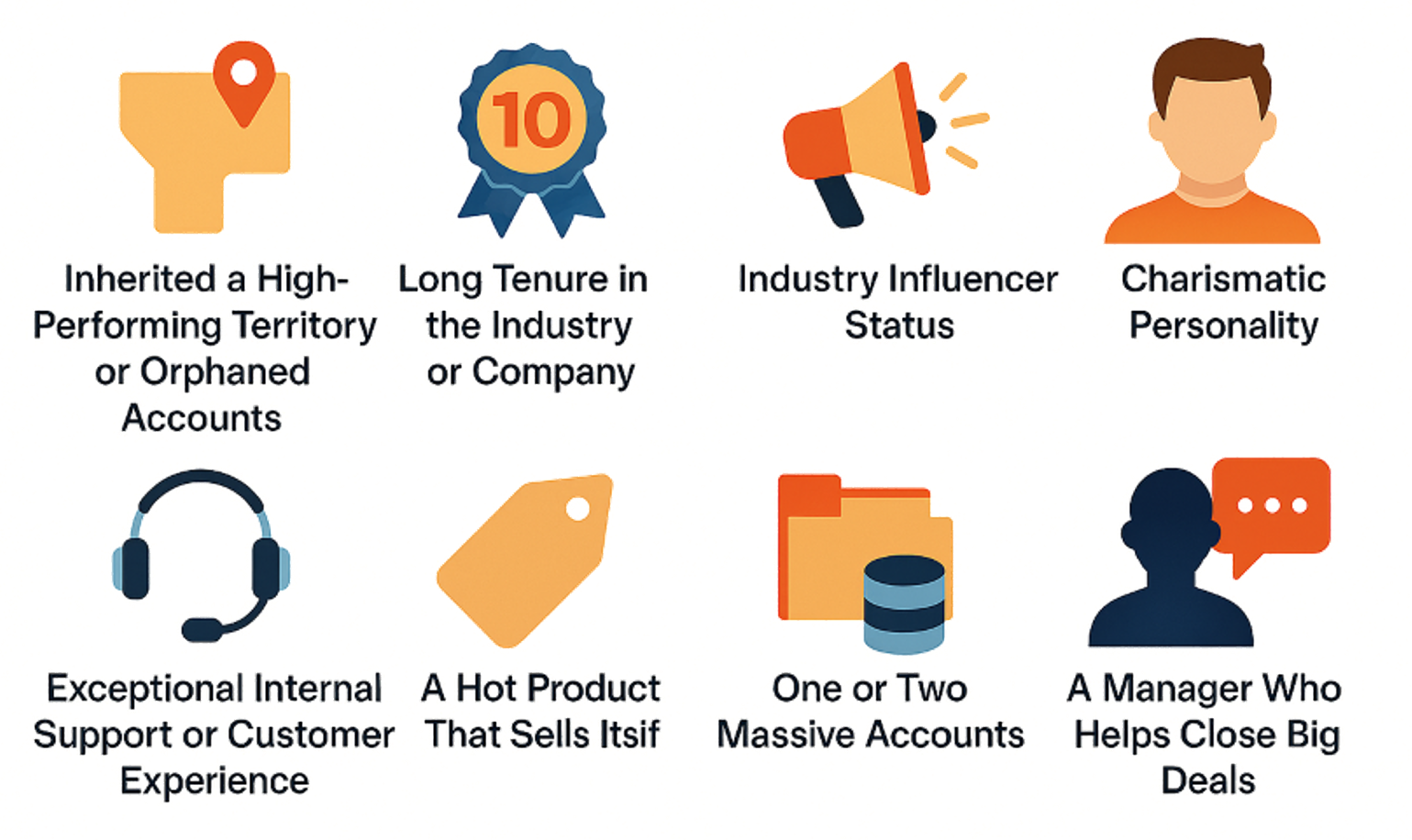
While some salespeople genuinely earn their results through skill, discipline, and consistency, others benefit from external or intangible factors that can inflate their perceived performance. Sometimes, favorable circumstances can make a rep look like a top performer when the numbers don’t tell the full story.
Here are 10 factors that can make a rep look like a star—without true top-performer capability.
- Inherited a High-Performing Territory or Orphaned Accounts: Reps may benefit from strong existing demand, loyal customers, or well-established relationships they didn’t build themselves.
- Long Tenure in the Industry or Company: Deep institutional knowledge and familiarity with internal systems can give reps an edge, even if their core selling skills are average.
- Industry Influencer Status: Personal brand recognition or thought leadership can attract attention and opportunities that boost performance metrics.
- Deep Customer Relationships Built Over Time: Long-standing trust and rapport can lead to easier renewals, upsells, and referrals — sometimes independent of current effort or skill.
- Charismatic Personality: Natural charm or likability can open doors and smooth over gaps in process or technique.
- Exceptional Internal Support or Customer Experience: Strong pre-sales, onboarding, and customer success teams can make deals easier to close and accounts easier to retain.
- A Hot Product That Sells Itself: When demand is high and differentiation is clear, reps may succeed without needing to deeply influence buyer decisions.
- One or Two Massive Accounts: A few large deals can skew performance metrics, making a rep appear more successful than peers with broader but smaller wins.
- Access to the Best Leads: High-quality inbound leads or cherry-picked opportunities can dramatically improve conversion rates.
- A Manager Who Helps Close Big Deals: Hands-on leadership in deal strategy or direct involvement in closing can elevate results beyond the rep’s individual contribution.
What Can Hide a True Top Performer?
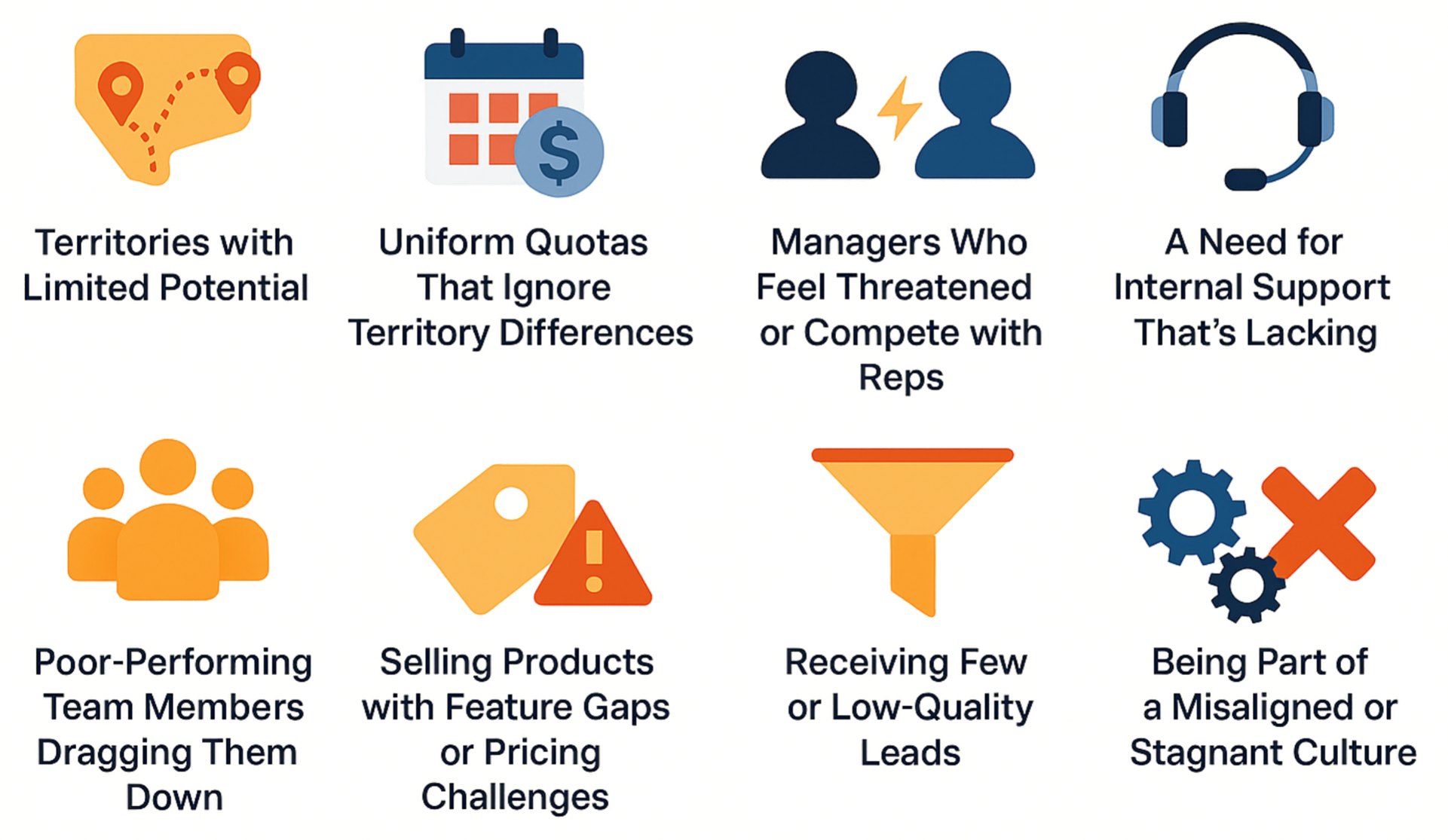
On the flip side, many high-potential reps face external constraints that limit their ability to shine. These factors can suppress performance metrics, masking true capability and leading to missed opportunities for development and promotion.
Here are 11 constraints that can mask the potential of high-potential reps.
- Territories with Limited Potential: Reps may be assigned regions with low demand, minimal brand awareness, or saturated competition, making success harder to achieve.
- Uniform Quotas That Ignore Territory Differences: Blanket targets can penalize reps in tougher markets while rewarding those in more favorable ones.
- Managers Who Feel Threatened or Compete with Reps: Leadership misalignment or internal competition can erode trust and limit support.
- New Hires Still Ramping Up: Even high-potential reps need time to learn the product, process, and culture before they can perform at full capacity.
- Industry Switchers Learning the Ropes: Reps transitioning from other industries may face a steep learning curve, despite strong transferable skills.
- A Need for Internal Support That’s Lacking: Without reliable pre-sales, support from sales engineers, onboarding, or customer success resources, reps may struggle to deliver value or close deals.
- Poor-Performing Team Members Dragging Them Down: Dysfunctional teams can create friction, slow down deals, and negatively impact morale and collaboration.
- Selling Products with Feature Gaps or Pricing Challenges: Reps may be at a disadvantage if the offering lacks differentiation or is priced unfavorably compared to competitors.
- Receiving Few or Low-Quality Leads: A lack of marketing support or weak lead generation forces reps to spend more time prospecting, reducing selling time.
- Navigating Operational Friction: Inefficient systems, slow approvals, or clunky processes can delay deals and frustrate both reps and buyers.
- Being Part of a Misaligned or Stagnant Culture: Cultures that resist change or undervalue enablement can stifle growth and limit rep development.
I’ve seen all of these, and probably more, over my many years in the sales profession.
Recognizing the Difference
Not all top performers are hidden. Many are rightly celebrated. But circumstantial top producers are often misclassified, and hidden performers often go unnoticed or uncultivated. So, what should you do with this knowledge?
Action Steps for Sales Leaders
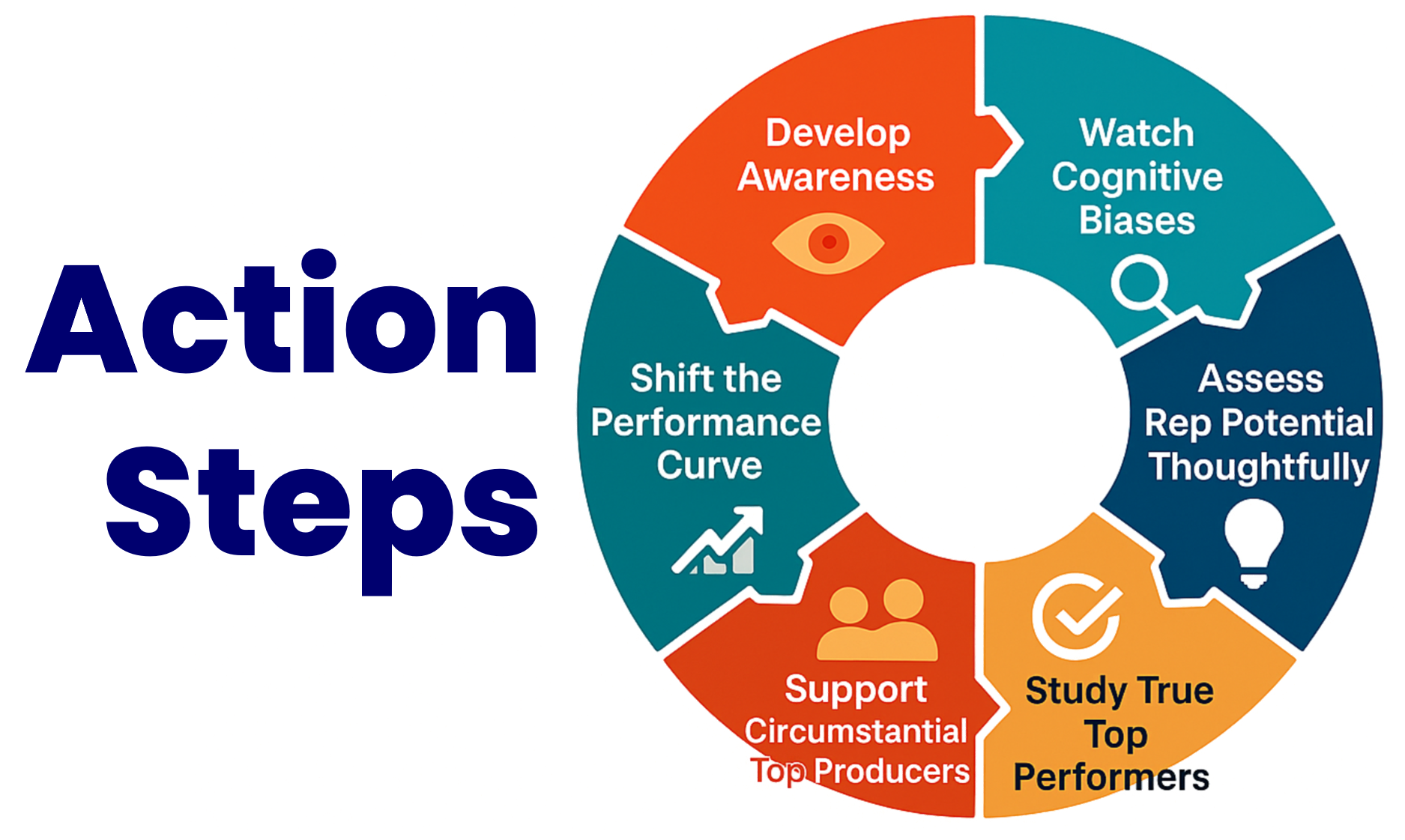
- Develop Awareness: Apply healthy skepticism to raw performance data. Look beyond revenue to understand context.
- Watch Your Cognitive Biases: Be careful of the halo effect and other biases, and avoid assuming everyone has the same opportunity despite contextual differences.
- Assess Rep Potential Thoughtfully: Ask whether a rep is someone you’d trust to build a new territory or manage key accounts. If not, they may be circumstantial top producers—not true top performers.
- Study Your True Top Performers: Learn what makes them successful. Invest in their growth. Use assessments to understand their strengths and replicate their success.
- Support & Coach Circumstantial Top Producers: With the right mindset and development, some may evolve into true top performers.
- Shift the Performance Curve: Use these insights to “move the middle”—elevating average performers and improving overall team results.
To reinforce this approach, consider refining:
- Measurement Systems to highlight replicable success
- Recognition Programs that reward the right behaviors
- Hiring and Training Systems aligned with top performer traits
- Sales Manager Development to enable effective coaching
- Territory and Quota Practices that reduce circumstantial bias
Discerning the difference between top producers and top performers isn’t just academic—it’s the key to building a scalable, high-performing sales organization. The payoff? A stronger, more consistent sales force—and better business outcomes.
Closing Thoughts
Of course, there’s much more you can do to build a high-performing sales force and drive meaningful business outcomes. But as you evaluate performance and make strategic decisions, remember that the biggest breakthroughs often come from shifting how you see success. By looking beyond the numbers, identifying the real drivers of top performance, and removing the constraints that hold back high-potential reps, you can unlock hidden value across your team.
Ready to Move Beyond the Numbers?
If you want to identify and replicate the traits of true top performers—and avoid the costly mistake of promoting circumstantial success—let’s talk. Together, we can build a sales force that consistently moves the needle on the metrics that matter most. Use the form below or connect with me directly.
Mike


Follow my work and connect
- Advisory Services & Coaching Programs: TSR Advisory Services & Coaching 2024
- The Building Blocks of Sales Enablement Book: https://bit.ly/BBofSE
- Sales Enablement Straight Talk Newsletter: https://bit.ly/SalesEnablementNewsletter-Kunkle
- Mike’s Linktree: https://linktr.ee/mikekunkle
- Modern Sales Foundations Blog: https://modernsalesfoundations.com/blog/author/mkunkle/
- Distribution Strategy Group Blog: https://distributionstrategy.com/author/mike-kunkle/
- Sales Effectiveness Straight Talk Webinars: https://bit.ly/MikeKunkle-OnDemand (60 Free Recorded Webinars)
- LinkedIn Articles: http://bit.ly/MK-LinkedInArticles
- LinkedIn Profile: https://www.linkedin.com/in/mikekunkle
- X.com: https://twitter.com/mike_kunkle
- Instagram: https://www.instagram.com/mike_kunkle/
- TikTok: https://www.tiktok.com/@mike_kunkle
- YouTube: https://www.youtube.com/@MikeKunkle/videos (Please Subscribe!)
About Mike
Mike Kunkle is a recognized expert on sales training, sales effectiveness, and sales enablement. He’s spent over 30 years helping companies drive dramatic revenue growth through best-in-class enablement strategies and proven-effective sales systems – and he’s delivered impressive results for both employers and clients. Mike is the founder of Transforming Sales Results, LLC and worked as the Vice President of Sales Effectiveness Services for SPARXiQ, where he designed sales training, delivered workshops, and helped clients improve sales results through a variety of sales effectiveness services. Mike collaborated with Doug Wyatt to develop SPARXiQ’s Modern Sales Foundations™ curriculum and also authored the Sales Coaching Excellence™ and Sales Management Foundations™ courses. His book, The Building Blocks of Sales Enablement, is available on Amazon, and The CoNavigator Method for B2B Selling is coming soon.
Discover more from MikeKunkle.com
Subscribe to get the latest posts sent to your email.
