Human Differentiators: A Powerful & Sustainable Competitive Advantage
CEOs, Sales Leaders, and Enablement Professionals of all flavors: Today, I want to talk about that thing we’ve said for years is our competitive advantage, but on which we rarely walk our talk. Yes, I’m referring to our people, our talent, and for us, specifically—our sales force.
“Our people are our competitive advantage.”
– Said by executives everywhere
Actually, people can be a competitive advantage. In fact, a significant one. But there’s often more potential than realization. And in B2B sales, there has never been a better—perhaps even necessary time—to capitalize on this potential and make it real.
Introduction
Why do I say that? Primarily because everyone’s scrambling to figure out how AI will change sales.
I understand why, but they’re asking the wrong question.
The real question isn’t “What will AI replace?”
It’s “What can’t AI replace?”
And the answer is simple. It’s the Human Differentiators.

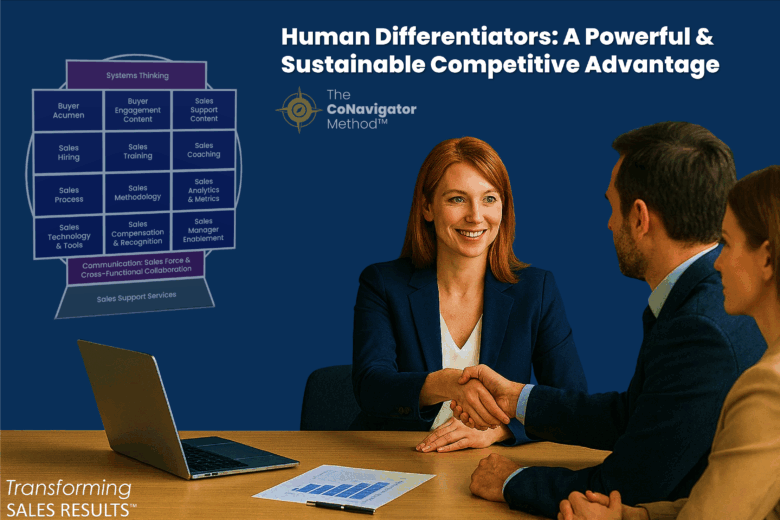
The Human Differentiators include things like empathy, active listening, expert judgment, consulting skills, critical thinking, problem-solving, guidance on contextual decision-making, evolving data to real insight, connecting the dots that may not be obvious, applying ethical persuasion (when an action is in the buyer’s best interests), using old-fashioned kindness and manners, and the ability to coach others to do all of the above. The big piece of this is making your buyers feel understood and supporting the emotions of decision-making (risks and the associated risk, personal value drivers, and personal motivators), as well as the logic. It’s about relationships, servant leadership, and trust.
Feeling understood is a very deep-seated human need. So are connecting with others and feeling supported. And if we’re being honest, in the Buyer-Seller dynamic today, we’ve royally messed up this opportunity, as a whole. Oh, sure, there are pockets of excellence—life is a bell curve. But if you can’t sense the need for significant change here, you may have your head in the proverbial sand.

So, in the rest of this post, I’ll dive deeper into a few things about this topic, and leave you with some options for getting help, if you want.
Let’s dig in.
Why This Matters Right Now
We’re all fond of saying that in today’s B2B sales landscape, the pace of change is accelerating. Buyers are more informed, more independent, and more skeptical than ever. They research online, consult peers, and often avoid salespeople altogether. They don’t want product pitches. They want partners who understand their business, communicate clearly, and help them solve real problems.
All of this is true.
Yet, the human brain, which has to absorb and reconcile all of this, evolves very slowly. We are emotional beings. We still go through the same process of making decisions as we have for millennia. Buying behavior has changed, but the primary reason is behavioral conditioning. Our poor selling behaviors have pushed buyers away. If salespeople were viewed as helpful and supportive, and were thought to operate in buyers’ best interests, buyers would not be trying so hard to avoid sellers.
Unfortunately, most sellers (and an equal number of sales managers and leaders) just haven’t wised up. Many still rely on outdated techniques, canned scripts, and seller-centric approaches that alienate rather than engage. The result? Missed opportunities, stalled deals, and frustrated buyers.
So what’s left? What can truly differentiate your sales force in a world where products are commoditized, pricing is transparent, and AI is automating everything?
The Human Differentiators, as shown and discussed above, are a powerful and sustainable differentiator. Or they can be.
Not just soft skills. Not just likability. But the ability to think critically, communicate authentically, and co-navigate complex decisions with buyers. These are the skills that top-performing sellers use to consistently outperform their peers—and they’re one of the few sustainable competitive advantages left.
How long have many executives said, “Our people are a competitive differentiator?” For years, right? But that doesn’t happen by magic. Look at the B2B buying research and what buyers think of sellers and tell me with a straight face that your sales force is a true differentiator. (I’ll wait here. And while you’re mulling on that, compare what your website says to your top 3 competitors’ websites and let me know if your marketing and messaging separate you from the pack, as well.)
The Problem with the Status Quo
Most sales teams are active. They’re making calls, sending emails, attending meetings, updating CRM fields, and chasing deals. But activity doesn’t equal effectiveness. And it certainly doesn’t equal improvement.
The problem isn’t effort—it’s alignment, adoption, consistency, and mastery. Sellers are often trained in disconnected concepts, coached inconsistently (if at all), and managed by metrics that don’t reflect buyer behavior or sales effectiveness. The result? A lot of motion, but not much progress.
We’ve all seen it:
- Reps who hit activity targets but miss quota.
- Managers who run pipeline reviews that feel more like status updates than coaching sessions.
- Teams that chase deals without understanding the buyer’s real decision criteria.
It’s not a lack of talent. It’s a lack of buyer-centricity, ineffective sales methods, and systems that fail to support sales effectiveness.
What Buyers Expect—and What They Feel They Get
I’ve mentioned some of this, but let’s look more closely. The juxtaposed data you see below is a mashup of two separate studies conducted by ValueSelling, Inc. and CSO Insights (now Korn Ferry). It’s pretty mind-blowing.
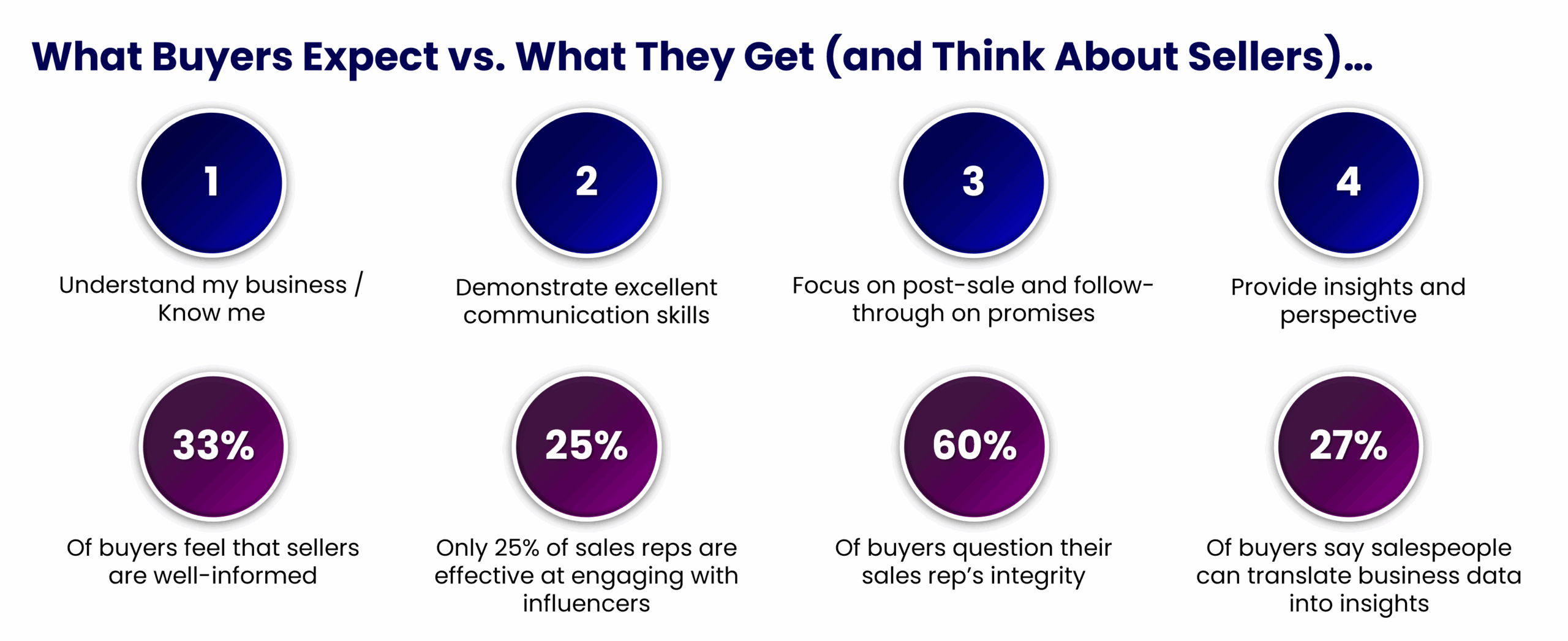
Here’s what buyers say they want:
- Understand my business. Know me.
- Communicate clearly and effectively, especially with executive decision makers.
- Provide insights and perspective. Help connect dots and “see around the corner.”
- Follow through on promises (integrity).
Here’s what they feel they get:
- Only 33% of buyers feel sellers are well-informed.
- Just 25% of sellers are judged effective at engaging with executives and influencers.
- A full 60% of buyers question their seller’s integrity.
- Only 27% say sellers can translate business data into insights.
That’s not just disappointing—it’s damaging. It erodes trust. It causes buyers to avoid sellers. It stalls deals. And it drives buyers to competitors who show up better.
What Top Sales Performers Do Differently
Over a 16-year period, I studied what the top 4% of B2B sales performers and the 16% below them do differently than average and low performers. These aren’t just the folks who hit quota—they’re the ones who consistently outperform, year after year, across territories, industries, and market conditions.
Some of what the top 4% do is hard to replicate—they often have intangible factors like deep industry expertise, highly developed business acumen, or charisma and force of personality. But the remaining 16% in the top 20%? They’re often once-average sellers who figured out “the magic sauce” in their industry, company, market, and solution set to consistently produce above-average results. Almost all of what they do is replicable, repeatable, and learnable.
These top performers don’t rely on charm, techniques, or brute force. There are patterns in the data. They follow a repeatable process. They use a surprisingly similar set of skills. They align with buyers, uncover real problems worth solving, message to develop interest and incite action, co-create solutions, and communicate value in ways that resonate. They qualify rigorously, manage stakeholders strategically, and gain commitment with confidence. And they do it all while building trust and delivering outcomes.
The Human-Centric Advantage
I’m currently turning my IP from these Top-Performer Analyses into The CoNavigator Method for B2B Selling—a new sales methodology and book that is 100% mine—to share these patterns. It’s a practical, buyer-centric methodology designed to help sellers align with buyers, co-create value, and drive growth. It’s not a flavor-of-the-month framework or a recycled acronym with a new coat of paint. It’s a system that reflects how elite sellers operate—and how you can, too.
At the heart of this method are human differentiators and the behaviors, patterns, and skills I’ve seen emerge from my research. Here are just a few of the models and concepts.
- ACC (Acknowledge, Clarify, Confirm): A communication model that builds respect and trust by demonstrating how well you understand your buyers.
- COIN-OP: A framework for understanding the buyer’s current situation, desired future state, decision drivers, and what they want to accomplish. (Challenges, Opportunities, Impacts, Needs, Outcomes, and Priorities).
- NASA (Need And Solution Alignment): A qualification lens to ensure you’ve got a great solution to solve your buyer’s problem or enable their opportunity and deliver the outcomes they need.
- POSE Value Stories: A simple but powerful way to tell value stories that resonate with buyers. (Problem, Outcomes, Solution, Explore).
- The Value Stack: A model that helps sellers build Awareness, Interest, and Relationship (AIR) to guide buyers through their decision process. Interest is comprised of four Value Drivers: Business, Execution, Purpose, and Personal.
These models aren’t just theory. They’re tools. They help sellers think critically, communicate authentically, and sell the way buyers want to buy. And they were all built based on observing many top performers over many years.
Francine’s Story: A Journey from Average to Top Performer
Francine is a fictional character I created to represent the top performers I surveyed, interviewed, engaged in focus groups, and observed in action. She is an amalgam of the best of the best in B2B sales. But it wasn’t always that way.
Before learning what I teach in The CoNavigator Method for B2B Selling, Francine was a driven and hard-working, but average producer at a company that sells high-quality air filtration systems. She worked hard, followed the playbook, and hit her activity metrics—but her results were inconsistent. Buyers were polite but not fully engaged. Deals frequently stalled, and her no-decision rates and loss rates were in line with the averages in the profession (which aren’t great).
Then she learned the concepts, models, frameworks, and skills in The CoNavigator Method, when her employer decided to implement a formal sales methodology.
She started asking better questions. She did research and sales call planning. She stopped talking about her product so much and started talking about her buyer’s business. She used the Situation Assessment with COIN-OP to uncover what really mattered. She used ACC to empathize and show she truly understood them. She co-created solutions with them, not for them. And she communicated value in ways that resonated with them (not just her product marketing team).
The difference was night and day. Buyers leaned in. They opened up. They saw her as a partner, not a “product pitcher.” Her win rates improved, but more importantly, her relationships deepened. That’s when she knew she wasn’t just selling anymore. She was co-navigating.
Six months later, she became the top salesperson at her company.
As I said, Francine’s story is modeled after the many top performers I studied. When I studied them, they were already at the top of their game. But they weren’t always, and they often had to figure things out on their own, over a far-too-long time frame.
The story I just shared above was one I heard quite frequently. And actually, I heard it not only from the top performers about their journey to the top, but also from average performers in my studies who benefited from the training that resulted from the top-performer analysis.
- For the top performers, sometimes a mentor helped them, sometimes a great sales manager and coach. And sometimes they just walked into a closed door enough times that they experimented and found the best way to make things happen.
- For the average performers, their journey up was usually a result of the training and the organizational support and coaching they received during and after the training.
But in the end, both had a journey like Francine’s, at some point. It is possible. Now imagine what it would feel like for you if you could get half of your sales force to improve. Or 75%?
The Business Case for Change
Look, I know I’m being pithy here. I’ve been hard on our profession in this post. I’m honestly not doing it to insult anyone. I think we need a strong wake-up call and a sense of urgency, because what I see us doing is more of the same, hoping for better results. And that’s not good for anyone. (Einstein agrees.)
There’s a certain amount of altruism in the best of the best, and I have seen most of them operate as servant leaders. They operate in their buyers’ and customers’ best interests, which is one way they separate themselves from the pack. But this isn’t just about doing the right thing for buyers. It’s about doing what’s necessary to deliver the best possible results for yourself and your company.
That’s the interesting thing about what I call “the pass-through principle.” When you focus just on getting results for yourself, you often don’t get them or can’t sustain them. When you focus on getting results for others, you end up accomplishing more for yourself.
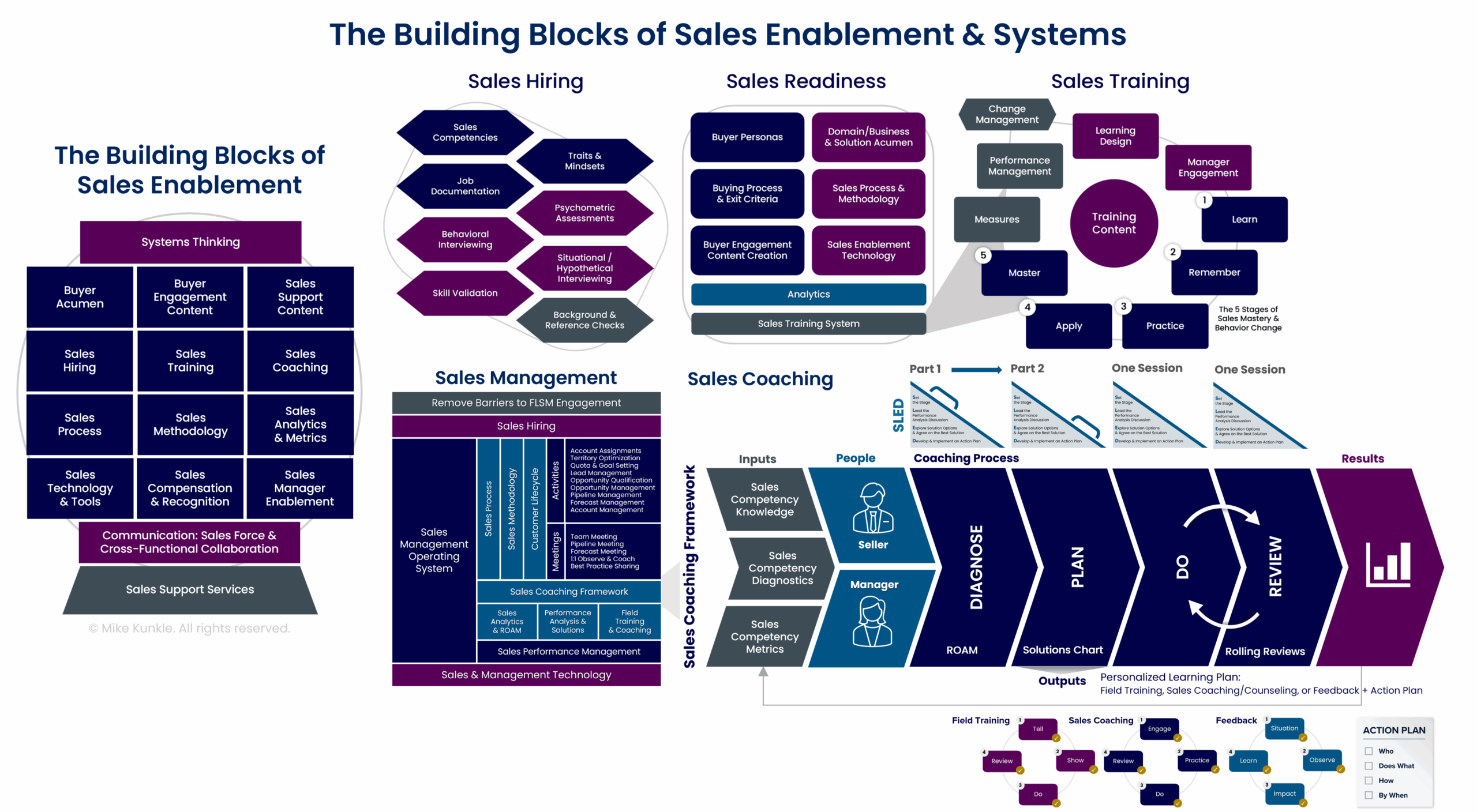
Here are just a few examples of what happens when companies invest in human differentiators and a buyer-centric way of selling (which is also consultative, value-focused, and outcome-oriented) and truly execute in such a way to get high levels of adoption and reach mastery. Add the supportive elements in The Building Blocks of Sales Enablement framework and sales systems, and that when the magic happens (meaning, radically improved sales results).
- Achieved a $398MM revenue increase and a $9.96MM net ROI in one year with full implementation of my enablement system.
- Increased sales per rep by 47% through changes in territory management, sales methodology, and coaching.
- Improved average profitability per sales rep by 11% in 4 months.
- Increased sales per employee in the 3-month period after training by 2.3 per month (average revenue increase of $183K per class of 12, or over $36.6MM over 12 months).
- Guided clients to achieve top-line sales growth of 12%, 12.6%, 19.1%, 25%, and 34% through sales methodology and sales coaching implementations.
These results weren’t achieved by pushing harder. The “Harder, Faster, Longer, Louder” method of sales management stopped working long ago. The above results were achieved by changing how sellers sell and creating the organizational systems to support it.
What You Can Do Next
If you’re a CEO, Head of Sales, or Enablement Leader, here’s my challenge to you:
Take a good hard look at how your team sells.
- Are they truly aligned with your buyers and customers?
- Are they using relevant messaging that resonates when prospecting?
- Are they co-creating value?
- Are they communicating value in ways that resonate with how your buyers perceive value?
- Are they managing opportunities and accounts with intention and rigor, focused on uncovering, clarifying, satisfying, and confirming satisfaction of buying process exit criteria (by decision maker, by stage)?
- Are they setting data-driven account objectives and developing logical account plans to achieve the objectives?
If not, it’s time to rethink your approach.
Closing Thoughts
Top performers don’t just sell; they co-navigate the buying journey with their customers. They lean into human differentiators to stay buyer-centric, consultative, value-focused, and outcome-oriented. That’s exactly what The CoNavigator Method delivers—with measurable impact.
Combine that with strong sales coaching and the organizational support of the Building Blocks system, and in twelve months you won’t recognize your sales force—or your results.
Even in the age of AI, human differentiators remain the most powerful—and sustainable—advantage you can have.If you’d like to explore how training, coaching, and consulting can help your team master these capabilities, let’s talk. You can reach me here on LinkedIn or through the contact form at the bottom of this page (scroll down, you can’t miss it): 👉 https://www.mikekunkle.com/services
Let’s build a sales force that buyers want to work with.
Resources
- The Scary Stuff That Salespeople Do and What to Do Instead!
- Value Engineering for Opportunity Management & Account Growth
- Beyond the Playbook: Why Teaching Salespeople to Think Is Your Best Competitive Advantage
- Stop Using Sales Techniques and Start Communicating Authentically!
- The Teachable Elements of Sales Effectiveness That Often Aren’t Taught
- COMING SOON: The CoNavigator Method website and my pending book, The CoNavigator Method for B2B Selling (the first in a CoNavigator series)
[NOTE: This article was originally published in my Sales Enablement Straight Talk newsletter on LinkedIn at https://www.linkedin.com/pulse/human-differentiators-powerful-sustainable-advantage-mike-kunkle-1kise/. It’s been edited and updated slightly here, but that’s the original source.]
Follow my work, connect, and/or work with me:
- Advisory Services & Coaching Programs: TSR Advisory Services & Coaching (ungated PDF download)
- The Building Blocks of Sales Enablement Book: https://bit.ly/BBofSE
- Sales Enablement Straight Talk Newsletter: Sales Enablement Straight Talk!
- Mike’s Linktree: https://linktr.ee/mikekunkle
- Modern Sales Foundations Blog: https://modernsalesfoundations.com/blog/author/mkunkle/
- Distribution Strategy Group Blog: https://distributionstrategy.com/author/mike-kunkle/
- Sales Effectiveness Straight Talk Webinars: https://bit.ly/MikeKunkle-OnDemand (60 Free Recorded Webinars)
- LinkedIn Articles: http://bit.ly/MK-LinkedInArticles
- LinkedIn Profile: https://www.linkedin.com/in/mikekunkle
- X.com: https://twitter.com/mike_kunkle
- Instagram: https://www.instagram.com/mike_kunkle/
- TikTok: https://www.tiktok.com/@mike_kunkle
- YouTube: https://www.youtube.com/@MikeKunkle/videos (Please Subscribe!)
About Mike
Mike Kunkle is an internationally recognized expert on sales training, sales effectiveness, and sales enablement. He’s spent over 30 years helping companies drive dramatic revenue growth through best-in-class enablement strategies and proven-effective sales systems – and he’s delivered impressive results for both employers and clients. Mike is the founder of Transforming Sales Results, LLC, where he designs sales training, delivers workshops, and helps clients improve sales results through a variety of sales effectiveness practices, sales systems, and advisory services. Mike collaborated with Doug Wyatt to develop SPARXiQ’s Modern Sales Foundations™ curriculum and also authored their Sales Coaching Excellence™ and Sales Management Foundations™ courses. His book, The Building Blocks of Sales Enablement, is available on Amazon, and The CoNavigator Method for B2B Selling is coming soon.
Discover more from MikeKunkle.com
Subscribe to get the latest posts sent to your email.
