
The Time-to-Value Fallacy: Why Adoption Beats Speed

Executive Summary
Sales leaders often chase fast sales training implementations to hit time-to-value targets. The problem? Research shows short programs rarely drive adoption or mastery—especially for a full methodology.
Extended, science-backed sales training using bite-sized learning, spaced repetition, retrieval learning and practice, and weekly manager support (including coaching) delivers far higher adoption. Over 75% adoption is the threshold where quality execution of a sales methodology starts producing meaningful revenue impact. It’s counterintuitive for some—but true.
The paradox is simple: longer implementation timelines generate faster, better, and more sustainable revenue growth because the training actually sticks. Fast doesn’t equal effective. Quality does.
Introduction: The Tension
I’ve had this conversation countless times in boardrooms and strategy sessions. A CFO turns to the Head of Sales and asks:
“How quickly can we get our reps trained?
We need fast time-to-value now.”
I get the pressure. Revenue targets are unforgiving. Boards have expectations. The impulse to move faster is natural—almost reflexive.
But there’s a hidden paradox in that question—one that’s costing companies millions in wasted training budgets and unrealized revenue potential.
The truth?
The sales training implementations that truly move the needle take longer than most leaders want to admit. Not because they’re inefficient, but because lasting behavior change requires time, repetition, and reinforcement.
That’s not opinion. That’s cognitive science.
You wouldn’t expect three weeks at the gym to build lasting fitness. Your sales team’s ability to execute a new methodology deserves the same realistic expectations. The methodology isn’t the gym membership. The methodology is the fitness.
In this article, we’ll explore why the quick-fix approach to sales training fails, the science behind why extended implementation works, when early value actually appears, and why the conversation needs to shift—from time-to-value to adoption-to-value. Because when your sales team truly adopts a proven methodology, everything else follows.
The Time-to-Value Illusion
Let’s start with what most executives think time-to-value means in sales training. It usually sounds like this:
“The new methodology is deployed. The training is complete. How quickly will we see results?”
I know this mindset well—I once worked for a President who asked that almost verbatim. Expectations were set high for the board; quotas were raised—despite my cautions that in a sales force of our size, it could take 18 months to realize the full predicted results. Not that we wouldn’t see early value, but it wouldn’t match the expectations set for the board or what becomes reasonable at 75% adoption with a high level of mastery.
The assumption is linear: training happens, results skyrocket.
- But that’s not how learning works.
- That’s not how behavior change works.
- And that’s definitely not how sales teams work.
Here’s what actually happens when organizations chase fast time-to-value. The methodology gets deployed, the training concludes, and then reps get pulled back into the reality of their day-to-day job. They have deals to close. They have numbers to hit. They have deeply ingrained habits built over years of experience.
Suddenly, the new methodology is competing with everything familiar—years of ingrained habits.
I once saw a company spend over a quarter million dollars rolling out a methodology. Eighteen months later—without reinforcement, cultural alignment, or coaching—they were selecting a new methodology because the first one “didn’t work.”
Without reinforcement, repetition, and manager coaching, reps revert. Research on the forgetting curve—first documented by Hermann Ebbinghaus in 1885 and reinforced by modern cognitive science—shows that without active retrieval practice and spaced repetition, people forget 50–80% of new information within days. That’s not a failure of your reps. It’s human memory.
The real definition of time-to-value should be the point at which your sales team has embedded the methodology deeply enough that it becomes their default behavior—their way of working, their reflex under pressure.
That takes time.
That takes repetition.
That takes manager support.
Sales organizations don’t rise to the level of their goals. They sink to the level of their training and systems.
The hidden cost of fast time-to-value is staggering. A rep trained but not adopting the methodology is a wasted investment. Across a sales force of 50 or 500 people, that wasted potential represents millions in unrealized revenue.
This is why companies with the potential to double revenue (without adding more bodies) rarely achieve their potential.
And here’s what leaders often miss: they assume that because training happened, adoption happened. It didn’t.
And that assumption costs companies billions annually.
Why Traditional and Fast Sales Training Fails: The Science
Understanding why fast sales training implementations fail requires grasping a few fundamental truths about learning and behavior change.
One-shot Training Doesn’t Overcome Ingrained Habits
Reps didn’t develop their current approach last month. They developed it through years of wins, losses, and lessons reinforced by commission checks. Those neural pathways run deep. A single event—no matter how well-designed—can introduce an idea but cannot embed a behavior.
The Forgetting Curve is Real
Ebbinghaus’ research, reinforced by more than a century of cognitive science research, shows that without reinforcement, knowledge decays rapidly. A 2013 study published in Psychological Bulletin reaffirmed that spaced learning with practice is one of cognitive psychology’s most robust findings.
If you train without follow-up, your people forget.
It’s not weakness. It’s biology.
There’s a Gap between Knowing and Doing
Performance consultants call this the “transfer gap.” Your reps can sit in a training room, understand the concepts, even ace a test. But on a call with a difficult buyer—under pressure to close deals, juggling priorities, exhausted from a long week—that training feels theoretical. Stress pushes them toward what’s comfortable, familiar, and what has worked before (even if it’s to a lesser degree, compared to the new methods).
Frontline Sales Managers are the Critical Multiplier that Fast Implementations Ignore
For over 30 years I’ve said this:
Frontline sales managers (FSMs) are the most overworked and underutilized asset in most organizations.
They are the link between training and behavior change—the coaches who make the methodology stick or allow it to dissolve.
Yet in most fast implementations, managers get a two-hour overview and maybe a quick playbook. That’s not enough to support adoption. That’s not enough to change how managers coach. Quick rollouts often treat managers as passive communicators, not as active coaches who embed the methodology through weekly reinforcement, feedback, and course correction.
Why Quick Programs Create False Confidence or The Danger Dip
After the training event, there’s usually a burst of enthusiasm. Reps try new approaches. Managers are energized. But I commonly see one of two challenges arise.
The Danger Dip
The first is what I call The Danger Dip.
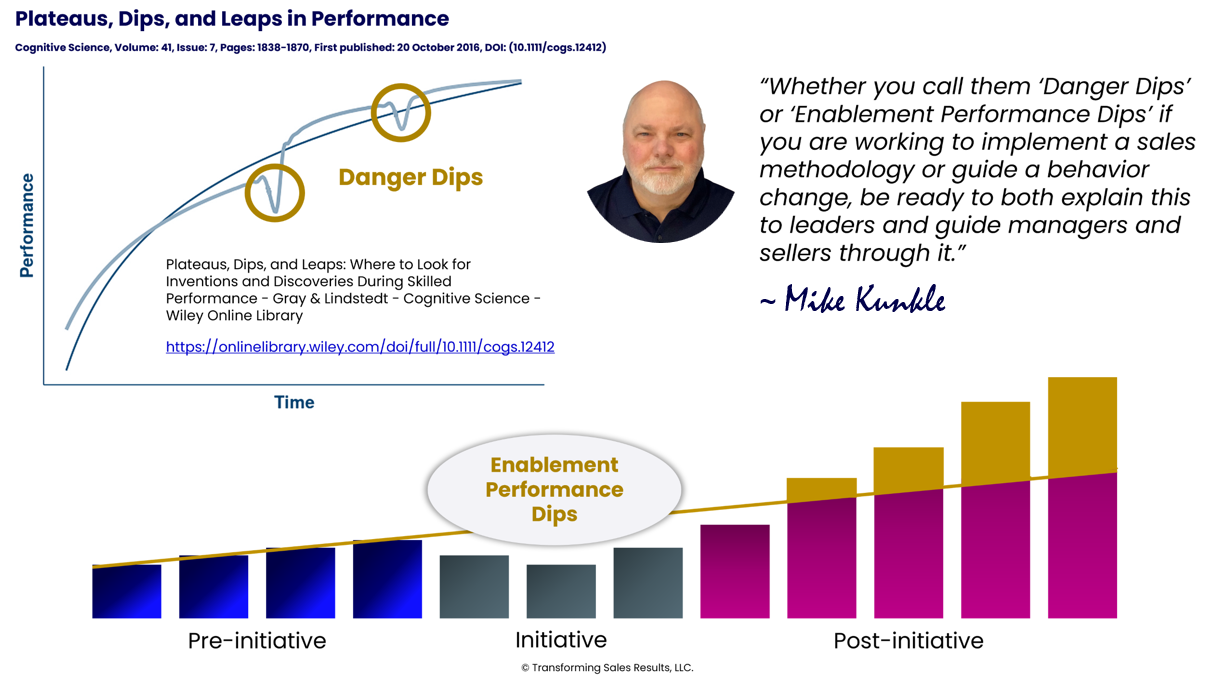 When people try new skills, they usually haven’t achieved mastery yet. This is why practice and coaching are critical—and part of my recommendations—but we know they don’t always happen. So instead, newly trained sellers try the skills, but they don’t execute flawlessly. Performance may dip before it picks up again and eventually exceeds previous levels.
Many methodologies have been abandoned in The Danger Dip.
The Reinforcement Gap
The second issue is what causes the dip—a lack of reinforcement, practice, feedback, and coaching. Without ongoing reinforcement, that initial enthusiasm fades. Leaders often measure adoption in the first few weeks, when enthusiasm is highest and behavior change looks visible. Even with a Danger Dip, some reps—usually top performers—will have success stories. Leaders declare success.
Six months later, adoption has eroded to 40–50 percent (or less). By then, it’s too late to course-correct, and restarting feels harder because people have already decided it “didn’t stick.”
This is why I’ve long called the traditional approach to sales management the “Harder, Faster, Longer, Louder” method.
When numbers start to slip, leaders add more technology, more emails, more calls, more activity. They don’t address the root cause: the methodology isn’t embedded, adoption isn’t deep, and managers aren’t coaching to a unified approach.
More activity without quality execution is waste. It annoys prospects. It erodes trust. And it doesn’t move the needle.
A Differentiated Approach: The Four Levers
So, what does an extended, science-backed sales training implementation look like? It’s built on four foundational elements that work together to transform knowledge into sustainable behavior change.
Bite-Sized Learning
Your sales reps are busy—managing pipelines, taking calls, traveling, and chasing quota.
A traditional approach locks them in a classroom for days or overloads them with massive content modules. Bite-sized learning recognizes that busy sales professionals need manageable chunks of information that fit into their workflow without causing cognitive overload.
Think 15- to 20-minute microlearning modules, not three-day seminars. Think focused topics, not comprehensive “everything-at-once” implementations. This approach respects their time, reduces overwhelm, and makes it practical to weave learning into the rhythm of their work.
Spaced Repetition
This is where the science shines. Spaced repetition means exposing learners to information at expanding intervals. You encounter a concept. You practice it. A few days later, you revisit it. A week later, you apply it in a different context—maybe through Q&A or retrieval exercises. A month later, you retrieve it again under conditions that mirror real selling.
Each retrieval strengthens neural pathways, moving knowledge from short-term to long-term memory—and eventually from memory to automatic behavior. Over a 34- to 36-week implementation, your sales team encounters core concepts multiple times, in varied contexts, with expanding intervals. By week 36, concepts that were new in week 1 have become second nature, while new layers have been added on top.
Retrieval Learning
Passive learning doesn’t work. Listening to a trainer explain a technique doesn’t embed it. Reading a playbook doesn’t make it yours. Retrieval learning forces learners to pull information from memory under conditions that mirror real-world application.
Your reps aren’t just hearing about discovery techniques—they’re asking discovery questions in role plays. They’re not just reading about resolving concerns—they’re responding to concerns in simulations, using the methodology model to resolve them. They’re not just understanding the value-driver framework—they’re writing and delivering business cases using it. This active retrieval under realistic conditions creates much deeper encoding and much stronger transfer to actual selling.
Weekly Manager Support & Coaching
This is the glue that holds everything together. Every week, frontline sales managers reinforce, coach, course-correct, and further embed the methodology. Managers receive training guides, understand which concepts are being reinforced that week, and know how to coach to those concepts. They have processes and questions that guide coaching conversations. They see which reps are struggling and intervene early.
This weekly cadence creates accountability, consistency, and continuous improvement. It also signals to the sales team that this methodology matters, that the organization is serious about it, and that adoption is non-negotiable.
These four elements don’t work in isolation. They’re symbiotic. Bite-sized content is manageable within a spaced repetition schedule. Retrieval learning activities happen throughout those intervals. Manager support reinforces both the spacing and the retrieval. Together, they create a compounding effect. Week by week, behavior shifts. Habits form. The methodology becomes how your team sells, not something they’re trying to do in addition to how they sell.
This isn’t theory—it’s the architecture of adoption.
The Adoption Curve: When Early Value Appears (Weeks 3-5)
One of the biggest misconceptions about extended sales training implementations is that there’s no value until the end—that leaders have to wait 34 weeks for any return on investment. That’s not true. In fact, if you’re not seeing value in the first few weeks, the implementation isn’t working or the methodology is not the right content for your company.
Here’s what the adoption curve really looks like:
Weeks 1 to 5: Early Wins in Specific Skill Areas
Based on how the training is organization and the order of modules, this is contextual. But in the first few weeks, reps and managers should start noticing improvements in discrete areas such as:
- More relevant buyer-centric communication
- Less friction and resistance with buyers
- Better discovery questions and deeper understanding of the buyers’ situation
- Tighter qualification
- Validation of Need And Solution Alignment (NASA)
- Clearer handling of concerns
- More confident value framing
These aren’t subtle improvements. Managers and reps notice them. Call quality scores tick up. Reps report that their discovery conversations feel more productive. This early value isn’t the full methodology. It’s the foundation. But it’s real. And importantly, it proves the methodology works.
Weeks 6–20: Core Skills Embed, Sales Velocity Improves
As you move into the second and third phases of the implementation, the training content builds on that foundation. Early modules are reinforced. New modules layer in. By week 12, your core sales team has been exposed to the fundamental methodology frameworks multiple times, in different contexts.
- Win rates start improving
- Sales velocity improves further
- Forecast accuracy gets better because opportunities are qualified more rigorously
Weeks 21–36: Mastery Phase and Compounding Impact
In the final phase, the methodology isn’t new anymore. It’s embedded. New hires come on board and get immersed into this methodology as the “way we sell.” Managers are coaching with fluency. Coaching conversations have evolved from “learn this” to “how do we refine this in this specific situation?” Revenue impact compounds. By week 24, you’re looking at measurable pipeline and win-rate improvements. By the end of the 36-week cycle, the organization has transformed.
- Adoption rates hit 75–80% or higher
- The methodology is woven into the culture
- Revenue lift is significant
Weeks 37+: The First Real Finish Line
When training ends, the real work begins.
I saw a video recently of a runner who was approaching the finish line. I think it was a steeplechase or half-marathon, so not a short sprint to the finish line. He was confident in his win and began to coast for the final few yards, preparing to cross the finish line with arms raised. When suddenly, much to his surprise, someone sprinted passed him toward the tape.
This reminds me of how organizations take their foot off the gas pedal too quickly for change management projects.
Like a runner who coasted too soon and lost the race, organizations that ease up after training risk losing the transformation.
When the training ends, ongoing coaching, worksheet usage, embedding concepts and form into CRM and workflow, competency gap identification and coaching to close gaps, are all requirements to truly cement a new methodology and transform it into “the way we do things around here.”
I’ve worked with clients across multiple industries and sales force sizes, and this pattern is remarkably consistent. The early value is real, but it’s not the finish line. Early value is the evidence that the method works and the foundation for exponential improvement.
Examples from Past Clients
Let me make this concrete:
- One mid-market software client I worked with saw measurable call quality improvements by week 4. By week 12, their qualification scores had improved to the point that weak opportunities were being eliminated, which freed up rep time for higher-quality deals. By week 24, their win rate had noticeably improved. By the end of their entended implementation, they had increased adoption to 85% and lifted their win rate from 18% to 28%. That’s not a small move. That’s a transformational move.
- A services provider I worked with implemented a new approach to value framing and business case development. By week 5, they started seeing better conversations around value in discovery. By week 12, their proposal templates had evolved and their sales reps were building more compelling business cases. By week 24, their proposal-to-close conversion rate had improved from 22% to 34%. By the end of implementation, that conversion rate had stabilized at 39%, adding over $1.2MM in annual bookings.
Reframe the narrative: Early value isn’t the goal. It’s proof of concept and the springboard for the compounding improvements that follow.
The Research: 75+% Adoption Moves the Needle
The reason I advocate for extended sales training implementation isn’t philosophical. It’s grounded in research and repeated real-world results.
Multiple studies confirm a consistent finding: companies with formal sales processes and methodologies that achieve 75% or higher adoption see statistically significant improvements in revenue plan attainment, individual quota achievement, and win rates.
Let me repeat that because it’s important: this finding shows up across multiple studies, across multiple industries, across multiple types of sales organizations. It’s not a one-off result. It’s a pattern.
The research is clear, but here’s what it also implies: below 75% adoption, the benefit may be marginal. Fragmented adoption means fragmented results. Some reps sell one way, others another. Pipeline forecasting becomes inconsistent. Coaching becomes difficult because there’s no unified framework to coach to. Revenue impact? Minimal.
At 75% adoption, something shifts. The organization moves in alignment. Most of your reps are executing the same core process and methodology. Coaching conversations become consistent. Your managers can focus on helping reps refine and master the approach rather than debating whether they should even follow it. Revenue impact becomes measurable and material. In one study, there was another statistically significant jump at 90% adoption.
Here’s where the time-to-value fallacy becomes obvious.
- A three-day or even three-week sales training implementation might achieve 25% to 50% adoption. Reps use pieces of it. Managers don’t reinforce it consistently. After 60 days, adoption has often slipped below 30 percent. Revenue impact is negligible. You’ve spent time and money on training and gotten minimal return.
- An extended 36-week implementation with bite-sized learning, spaced repetition, retrieval practice, and weekly manager support often achieves over 75% percent adoption. That adoption holds because it’s been embedded through repetition and reinforcement. Revenue impact is material and sustained.
The math is straightforward:
- A 3-week training with 35% adoption equals near-zero ROI.
- An extended program with 75% adoption can equal significant incremental revenue.
The question isn’t the length of the program. The question is adoption rate and the resulting revenue impact.
Reframing the Conversation: The Questions Executives Should Ask
If you’re a sales leader or CEO, I’d like to challenge the questions you’re asking about sales training right now.
- Stop asking: “How fast can our reps use this?”
- Start asking: “How will our reps remember and apply this under real-world pressure?”
The first question assumes that exposure equals adoption. It doesn’t. The second question focuses on the real outcome: sustainable behavior change.
- Stop asking: “What’s the time-to-value?”
- Start asking: “What adoption rate will we achieve, and what’s the resulting revenue impact?”
Time-to-value is a false metric if adoption is shallow. Adoption-to-value is the actual metric that matters.
- Stop asking:“Can we compress this into eight weeks?”
- Start asking: “What support structure will drive adoption? What manager training do we need? What coaching cadence is required?”
Compression usually means cutting the reinforcement. It means reducing manager support. It means hoping reps will stick with the methodology without ongoing coaching. That’s how implementations fail. Change management by decree does not work.
- Stop asking: “When will we see ROI?”
- Start asking: “When will our reps demonstrate mastery, and when will we reach 75+% adoption?”
Mastery and adoption are the leading indicators of revenue lift. If you focus on those, ROI follows naturally.
- Shift the accountability question entirely: “Is our organization committed to the reinforcement and coaching this requires? Or are we looking for a quick fix that won’t stick?”
This is the real question. Because extended implementation requires sustained commitment from leadership, from managers, and from the sales team. If that commitment isn’t there, no sales training will work.
The True Cost of Shortcuts
Let’s talk about what really happens when organizations chase short sales training implementations and quick time-to-value.
Quick-fix implementations create short-lived behavior change, which leads to regression to old habits. Your reps try the new approach for a few weeks. Then, under pressure, with deals at risk, and old habits pulling at them, they revert. They return to what’s familiar, what’s comfortable, what worked before. You’ve paid for training that produced no lasting change.
But here’s where it gets worse: organizations that chase quick fixes often enter a cycle of repeated training initiatives.
- A new methodology gets deployed. It doesn’t stick.
- Three months later, sales leaders look for the next solution.
- Another program gets launched. It also doesn’t stick.
- This cycle repeats every 18–24 months.
Each failed initiative erodes confidence:
- Reps become cynical: “Here we go again—another flavor-of-the-month program that won’t stick.”
- Managers lose credibility: They’re asked to champion yet another initiative that will likely fail like the last one.
- Leaders become jaded: Doubting whether training and enablement can actually move the needle.
Meanwhile, your competitors who implement rigorous methodology correctly are pulling away. They invest in a low, slow implementation. They achieve 80% adoption. By the time your organization is starting its next quick-fix program, their teams have been executing with discipline for nine months. They’re in their mastery phase. Their revenue is growing. Your cycle of failed initiatives continues.
The real cost of shortcuts isn’t the months spent implementing. It’s the repeated investments that never mature, the compounded skepticism, the organizational friction, and the revenue that stays flat while competitors grow.
Shortcuts don’t save time—they waste it.
Implementation Reality Check: Setting Expectations
Let’s be honest: a 34- to 36-week extended sales training implementation is demanding. It requires manager commitment. It requires organizational discipline. It requires patience. It requires senior leadership to keep the initiative in focus—even when competing priorities are screaming for attention.
But here’s what’s equally true:
Lasting behavior change and sustainable performance improvement require a longer-term commitment.
This mirrors change management timelines across industries for organizational transformation. You wouldn’t expect to transform your company’s culture in eight weeks. You shouldn’t expect to transform how your sales team sells in eight weeks either.
Acknowledging the ask is important.
Acknowledging the ask matters:
- Yes, it requires manager time.
- Yes, it requires discipline.
- Yes, it requires organizational patience.
But the payoff—sustainable adoption, predictable revenue lift, reduced churn, improved customer satisfaction—justifies the investment.
Key Milestones
Here’s what I’ve often told clients about the milestones:
- Week 5: Early module wins are visible. Reps and managers see tangible improvement in specific skills. Call quality shifts. Buyer conversations feel more productive. More meetings are set. Leadership gets early proof that the methodology works.
- Week 12: Core methodology concepts have been exposed multiple times in different contexts. Coaching conversations have evolved. Adoption is gaining momentum. Win rate improvements start to emerge.
- Week 24: Pipeline and win-rate improvements are measurable. The organization gains confidence. Momentum builds. This is often the point where leadership stops questioning whether the initiative will work and starts planning how to sustain it.
- Week 36: Methodology is woven into culture. New hires onboard into this methodology as the “way we sell.” Managers coach with fluency. Adoption has reached 75 to 85 percent. Revenue lift is material and compounding.
- Week 37+: Results vary based on the size of the organization, but it can take 24-36 months (not weeks) to completely embed a full-cycle sales methodology into the culture, without risk of bouncing back or reverting to a seller-led, free-for-all approach to selling.
Even conservative financial models show payback within six to nine months when adoption reaches 75% or higher. A $200K investment in a 36-week implementation typically produces millions in incremental revenue by month 12. That’s not speculation. That’s been repeated across organizations of various sizes and industries.
Closing Thoughts
Let’s bring this together.
The time-to-value conversation has been framed wrong. It’s been framed as “How quickly can we deploy training?” when it should be framed as “How do we ensure sustainable adoption—and the revenue impact that follows?”
The Paradox is Real:
- Extended implementations produce faster revenue growth because the training sticks and is used.
- Quick programs promise speed and deliver regression.
- Extended programs demand patience and deliver results.
The real risk isn’t investing 36 weeks in rigorous, science-backed sales training. The real risk is wasting time and money on programs that never embed, adoption that never takes hold, and revenue that stays flat.
You’re not choosing between fast and slow. You’re choosing between training that works and training that disappears.
Here’s My Challenge for You: Audit your current sales training outcomes right now.
- What’s your adoption rate?
- What’s the resulting revenue impact?
If adoption is below 75% and revenue impact is minimal, the answer isn’t faster training. The answer is evidence-based rigor that drives real behavior change and mastery.
The question isn’t whether you have 36 weeks. It’s whether you can afford not to invest them—given the alternative is repeated cycles of training that fail to take hold, adoption that never materializes, and revenue that stagnates while your competitors pull ahead.
Speed feels good. Results feel better.
If you want to have a conversation about how extended, science-backed sales training implementation can transform your sales organization and drive sustainable revenue growth, I’m here. Reach out on LinkedIn or visit mikekunkle.com/services to connect.
Until then, stay focused on adoption. Stay committed to reinforcement. Stay patient with the process. That’s where the breakthrough happens.
How to follow my work, connect, and work with me:
- Advisory Services & Coaching Programs: TSR Advisory Services & Coaching (ungated PDF download)
- The Building Blocks of Sales Enablement Book: https://bit.ly/BBofSE
- Sales Enablement Straight Talk Newsletter: Sales Enablement Straight Talk!
- Mike’s Linktree: https://linktr.ee/mikekunkle
- Modern Sales Foundations Blog: https://modernsalesfoundations.com/blog/author/mkunkle/
- Distribution Strategy Group Blog: https://distributionstrategy.com/author/mike-kunkle/
- Sales Effectiveness Straight Talk Webinars: https://bit.ly/MikeKunkle-OnDemand (60 Free Recorded Webinars)
- LinkedIn Articles: http://bit.ly/MK-LinkedInArticles
- LinkedIn Profile: https://www.linkedin.com/in/mikekunkle
- X.com: https://twitter.com/mike_kunkle
- Instagram: https://www.instagram.com/mike_kunkle/
- TikTok: https://www.tiktok.com/@mike_kunkle
- YouTube: https://www.youtube.com/@MikeKunkle/videos (Please Subscribe!)
About Mike
Mike Kunkle is an internationally recognized expert on sales training, sales effectiveness, and sales enablement. He’s spent over 30 years helping companies drive dramatic revenue growth through best-in-class enablement strategies and proven-effective sales systems – and he’s delivered impressive results for both employers and clients. Mike is the founder of Transforming Sales Results, LLC, where he designs sales training, delivers workshops, and helps clients improve sales results through a variety of sales effectiveness practices, sales systems, and advisory services. Mike collaborated with Doug Wyatt to develop SPARXiQ’s Modern Sales Foundations™ curriculum and also authored their Sales Coaching Excellence™ and Sales Management Foundations™ courses. His book, The Building Blocks of Sales Enablement, is available on Amazon, and The CoNavigator Method for B2B Selling is coming soon.
Discover more from MikeKunkle.com
Subscribe to get the latest posts sent to your email.
