Your Sales Methodology Execution Gap Is Costing You Millions!

In this post, I’ll explore one of the most consequential (and most ignored) business problems hiding in plain sight inside middle-market companies: the staggering performance gap that opens up when your sales team operates without a formal, buyer-aligned sales process and a cohesive sales methodology that sellers actually adopt and managers actually coach to.
We’re going to look at the real numbers—from CSO Insights’ Fifth Annual Sales Enablement Study, from labor market research on middle-market companies, and from independent sales performance analyses—and then walk through what those numbers actually mean in dollars for a company. (Note: CSO Insights was acquired by MHI Global in 2015, and following MHI Global’s acquisition by Korn Ferry in 2019, was integrated under the Korn Ferry umbrella.)
- Spoiler Alert: the revenue gap mentioned above is far bigger than most CEOs and CROs realize. And closing it doesn’t require adding headcount.
Introduction: The Problem Nobody Wants to Name
Let’s start with a question that might hurt a bit:
“What percentage of your sales reps hit quota last year?”
It often gets quiet when I ask this. A few people mumble. Someone laughs nervously. Because the honest answer, for most companies, is painful.
According to RepVue’s Cloud Sales Index, only about 43% of sellers hit quota in the first half of 2024—and that number has hovered in the low-40s for six consecutive quarters. Let that sink in. In the average sales organization, more than half of your quota-carrying sellers are missing their number. Every quarter. Year after year.
- Sidebar Disclaimer: Not having been born yesterday, I am well aware that some of this problem may result from horrible quota-setting practices. Noted. But when there is a declining 10-year trend measuring the same way and setting quotas the same way, it is still pretty indicative of a problem beyond quota-setting practices.
Now combine the quota attainment decline with this: the National Center for the Middle Market (NCMM) identifies approximately 200,000 middle-market firms in the U.S.—companies with $10M–$1B in annual revenue—that collectively account for about one-third of private-sector GDP. These aren’t tiny startups or Fortune 500 giants. They’re the backbone of the American economy. And most of them are leaving a stunning amount of revenue on the table because their sales execution is flying without instruments.
This post is the business case for changing that. Not with more reps. Not with a new CRM. With something far more fundamental: a formal, buyer-aligned sales process and a formal sales methodology that sellers adopt and managers reinforce through structured coaching and workflow integration.
The data will show you exactly what’s possible. Let’s dig in.
The State of the Average Middle-Market Sales Force
Who Are We Talking About?
I’ll use the middle market as an example throughout, so we can get into some real numbers. The National Center for the Middle Market (NCMM) defines middle-market companies as those with $10M–$1B in annual revenue. There are roughly 200,000 of them in the U.S., employing around 44.5 million people—that’s an average of about 220–225 employees per firm.
What does the sales team look like at a company that size? According to Pave’s 2025 compensation dataset (drawn from over 2,900 companies with more than 50 employees), sales functions comprise roughly 12–14% of headcount at companies with 200–1,000+ employees. Apply that to our “average” middle-market firm and you’re looking at approximately 26–31 sales roles—a mix of account executives, SDRs/BDRs, account managers, sales engineers, and related quota-carrying positions. For our model, we’ll use 27 sellers.
The Quota Attainment Reality
Here’s where things get uncomfortable. As noted above, approximately 43% of those sellers are hitting quota in any given period. That means, in our representative middle-market firm with 27 sellers, roughly 12 reps are consistently achieving their number. Fifteen are not.
Before you dismiss this as a “hiring problem” or a “motivation problem,” let’s explore what the research actually says is driving it.
“The data points clearly: random and informal approaches to sales enablement fail to reach even average results—and may be worse than doing nothing.”
~CSO Insights Fifth Annual Sales Enablement Study
CSO Insights’ Fifth Annual Sales Enablement Study (conducted across 918 organizations worldwide) found that the overwhelming majority of organizations—those with random or informal sales enablement approaches—couldn’t achieve even average results across the three core sales KPIs: win rates, quota attainment, and revenue plan attainment. More striking still: a random or informal approach to enablement may actively drag performance below what it would be with no enablement at all.
The culprit isn’t talent. It’s the system—or more precisely, the absence of one.
What Research Shows About Process and Methodology
Formal Enablement Moves the Needle
Let’s talk numbers directly from the CSO Insights study, because these deserve to be seen clearly:
- Organizations with formal sales enablement posted win rates of 49.0% vs. 42.5% for those without—a 15.3% relative improvement.
- Revenue plan attainment: 103.6% with formal enablement vs. 101.0% without.
- Quota attainment: 61.2% with formal enablement vs. 59.8% without.
Those headline numbers are meaningful, but they’re actually the floor, not the ceiling. The real performance gains come from the layers beneath.
Buyer Alignment: The Multiplier
CSO Insights identifies four levels of how well an organization’s internal selling process aligns with the customer’s actual buying path: random, informal, formal, and dynamic. Only 19% of organizations in the study had achieved dynamic alignment—meaning they had not only mapped their sales process to the buyer’s journey but also built in mechanisms to adapt that process as buyer behaviors change.
That 19% achieved something remarkable:
- 9% improvement in win rates vs. the study average
- 8% improvement in quota attainment vs. the study average
Read that again. Nearly 18 more percentage points on win rates. Nearly 12 more percentage points on quota attainment. From alignment. Not from hiring better reps. Not from a new comp plan. (Not that either of those things are bad ideas, but the leverage of formal process and methodology is an outlier in terms of the results it can produce.)
Adoption Is the Unlock
Here’s something the research makes unmistakably clear: having a process or methodology isn’t enough. The performance gains are directly tied to how widely and consistently the sales force actually uses them.
CSO Insights analyzed performance at different levels of sales process and methodology adoption and found a striking staircase effect:
- At less than 25% adoption: revenue plan attainment of 97.6%, quota attainment of 49.4%, win rate of 40.4%—all below average.
- At 76–90% adoption: revenue plan attainment jumps to 106.7%, quota attainment to 64.0%, win rate to 54.1%.
- At greater than 90% adoption: revenue plan attainment reaches 112.5%, quota attainment reaches 72.4%, win rate reaches 57.8%.
This may be the most important table in sales enablement research, and most organizations have never seen it, or worse, have seen it and ignored it. At greater than 90% adoption, you’re not just beating average—you’re operating in a completely different performance tier.
“At greater than 90% process and methodology adoption, organizations achieve 112.5% of revenue plan, 72.4% quota attainment, and 57.8% win rates—all dramatically above study averages.”
~CSO Insights Fifth Annual Sales Enablement Study
Coaching: The Reinforcement Engine

Implementing a formal sales process and sales methodology alone won’t get you to high adoption. That requires coaching—and not the random, inconsistent kind that most organizations rely on. Not just deal coaching. Not just firing off feedback. Real, skills-based, behavioral coaching that improves performance across all deals.
The CSO Insights study is emphatic on this point: dynamic sales coaching (formally structured, aligned to the sales process and methodology, consistently delivered by frontline managers, and tailored to individual rep needs) produces dramatically better outcomes than leaving coaching to individual manager discretion.
- Win rates with dynamic coaching: 55.2% vs. 41.8% for the random approach—a 32.1% improvement.
- Quota attainment with dynamic coaching: 21.3% above the study average, and 27.9% better than the random approach.
And yet 62.9% of organizations in the study still follow a random or informal coaching approach. Which means…
Most companies have their single biggest performance lever sitting untouched.
Workflow Integration: The Compound Effect
One more data point worth flagging: when sales enablement technologies are integrated into CRM and other engagement and enablement tools—rather than existing as standalone point solutions—quota attainment was 6.8% higher than average, and win rates were 4.1% higher. This isn’t magic; it’s what happens when the process lives in the seller’s daily workflow rather than in a binder or a training event they attended 18 months ago.
What the Execution Gap Is Costing Your Company in Real Dollars
The Model
The numbers above are meaningful in isolation, but let’s make them tangible. Here’s a transparent, conservative financial model you can adapt for any middle-market company. I’ll show the assumptions explicitly so you can stress-test them.
A quick note before we run the numbers: the scenarios below are intentionally illustrative. The inputs are drawn from the best available public data, and the assumptions are shown explicitly so you can substitute your own. This is a directional model, not a financial audit. The point is to give you a credible framework for sizing the opportunity—not a number to put in a board deck without your own validation.
Baseline inputs:
- 27 sellers (as derived from NCMM and Pave data above)
- Current quota attainment: 43% of reps hitting quota (RepVue)
- Target quota attainment: 72.4%—the CSO Insights figure for organizations at greater than 90% process and methodology adoption
- Sales-influenced revenue: 70% of total revenue (conservative; accounts for contractual carryover and non-sales channels)
- Year-1 ramp adjustment: 0.6 (accounts for mid-year rollout)
- Year-1 realization factor: 0.7 (accounts for adoption curve and coaching maturity)
- Combined Year-1 realization: 42% of full potential
- Current effective sellers (hitting quota): 43% × 27 ≈ 12
- Target effective sellers (at 72.4% attainment): ≈ 19–20
Net gain: 7–8 more sellers consistently hitting quota—from system improvement, not headcount addition.
The Scenarios
Here’s what that translates to across three revenue scenarios:
Scenario A—$50M company:
- Sales-influenced revenue: $35M
- Revenue per effective seller today: $35M ÷ 12 ≈ $2.92M
- Year-1 incremental revenue: $2.92M × 7 × 0.42 ≈ $8.6M
- That’s 17% of total revenue from process and methodology formalization alone.
Scenario B—$100M company:
- Year-1 incremental revenue: ≈ $17.2M
Scenario C—$250M company:
- Year-1 incremental revenue: ≈ $43.1M
And these are conservative estimates. They exclude:
- Reduced seller turnover (lower recruiting, hiring, and ramp costs—CSO Insights found fully engaged sales forces had voluntary turnover rates nearly 40% lower than disengaged ones).
- Shorter sales cycles (which expand capacity without adding headcount). Special note: shorter sales cycles are a result of doing other things better. Pushing buyers to improve deal velocity almost always backfires.
- Larger average deal sizes (a documented byproduct of structured methodology adoption).
- The CRM-embedded technology uplift (+6.8% quota attainment, +4.1% win rates) documented above.
- Compounding Year-2 and Year-3 effects as adoption matures toward the greater-than-90% tier.
Now ask yourself: What’s your CFO’s threshold for a business case worth funding?
What to Do About It: The Implementation Roadmap
The research tells us what works. Here’s how to sequence it.
Step 1: Establish a Formal Enablement Charter and Executive Sponsorship
CSO Insights found that organizations with a formal and charter-based sales enablement approach—one with a documented vision, goals, strategy, and roadmap—achieved win rates of 55.1% vs. 39.2% for those with a random approach. That’s a 16-point gap from formality alone, before any specific initiative is even deployed. This is why I always start with a charter.
The charter isn’t bureaucracy. It’s the alignment mechanism that ensures your sales enablement investments connect to actual business strategy and measurable outcomes—and that executive sponsors stay engaged rather than checking out after the launch event. RACI or RASCI can clarify roles nicely, too.
Step 2: Build a Buyer-Aligned Sales Process

This is the “what and when” of selling. Map your customers’ actual buying paths—the steps, decision gates, and commitment points buyers move through on the way to a decision. Then translate those into your internal sales process stages with verifiable outcomes and required buyer commitments at each stage. Not pipeline stages for CRM hygiene. Actual buyer-aligned stages that reflect reality.
The goal is to eliminate the misalignment—the “we’re at 80% close probability” that turns out to be a 0% because the buyer wasn’t actually where the seller thought they were.
Step 3: Adopt a Formal Sales Methodology
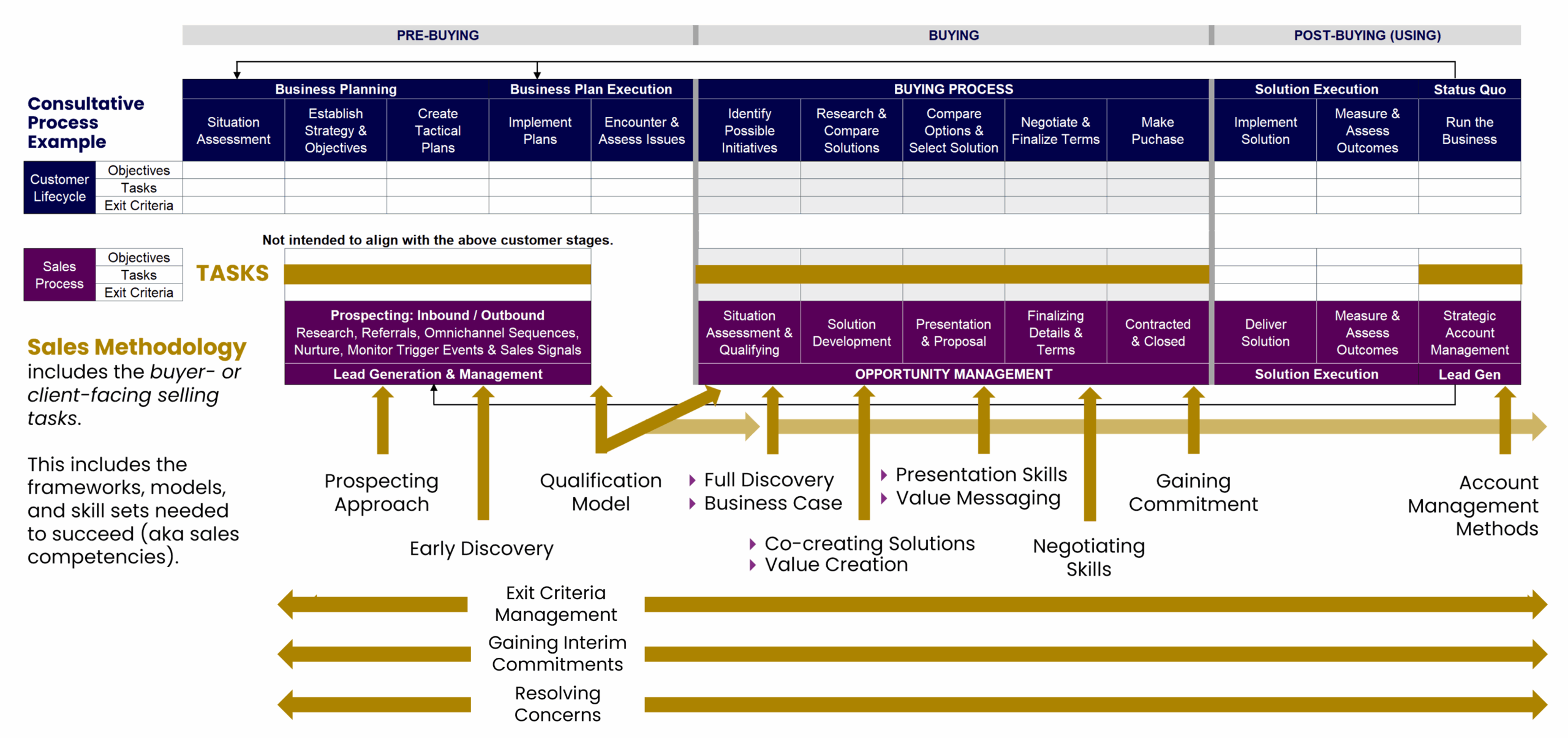
The sales process tells sellers what to do and when. A sales methodology tells them how to execute—how to run discovery, how to build consensus in a multi-stakeholder deal, how to navigate concerns and gain commitments. Process without methodology produces inconsistent execution. Methodology without process produces skilled sellers going in the wrong direction.
The specific methodology you choose matters less than the choice to formalize one. Whether you adopt an established framework, license a commercial methodology, or build something proprietary, just do it. I obviously recommend my CoNavigator Method for B2B Sales Mastery, which is designed around buyer-aligned navigation of complex sales, based on how to top 1-4% of top performers sell. But whatever you chose (as long as it’s modern, buyer-centric, consultative, and value-focused), the point is that your sellers need a shared language, shared plays, and shared standards. Then they need to be trained on it, coached to it, and held accountable for using it.
Step 4: Enable Managers First, Not Last
This is where many enablement programs fail. Companies invest in seller-facing training and assume managers will figure out the coaching piece on their own. They won’t—at least not consistently. CSO Insights found that when managers use a dynamic coaching approach aligned to the sales process and methodology and focused on individual rep needs, quota attainment is 21.3% above average and win rates are 19.0% above average. That doesn’t happen by accident.
Frontline managers need to be trained on the methodology before their sellers are. They need structured coaching frameworks, defined cadences, and the tools to provide feedback that’s tied to specific stages and skills—not just intuition and war stories from their own selling days.
Step 5: Embed Everything into Workflow
Training events fade. Binders collect dust. What sticks is what lives in the daily workflow. Build your process stages, buying process exit criteria, next-best-action prompts, and content assets into your CRM and engagement and enablement systems. When a seller opens an opportunity record, the methodology should be right there—guiding the next conversation, surfacing the right content, flagging the gaps.
This is how you get to greater than 90% adoption. Not by mandating it, but by making it the path of least resistance.
I’ve come to think of this as my Adoption & Mastery Mantra—five principles that describe exactly how formalization becomes performance:
- What gets asked about gets focus.
- What gets measured gets done.
- What gets integrated into workflow gets adopted.
- What gets coached gets mastered.
- What gets mastered moves the needle.
Read those in sequence and you’ll feel the whole implementation roadmap compressed into five lines. Each step in this section maps to one of them. Miss one, and the chain breaks.
Step 6: Measure What Matters
Define your leading and lagging indicators before you launch, not after. Adoption rates (process and methodology usage), win rates, quota attainment, revenue plan attainment, sales velocity, and coaching activity quality are all measurable. Track them consistently. Adjust quarterly. The CSO Insights data shows that formalized collaboration and production models—the inner workings of enablement—when implemented correctly, lifted quota attainment 13.1 points above average. The inner workings matter.
Closing Thoughts
Here’s the honest summary:
Most sales organizations operate at roughly half their potential.
Not because their people aren’t capable. Because the system hasn’t been built to consistently bring out the best of their capability.
And in case this isn’t obvious, if you think this doesn’t apply to your middle market or even enterprise organization, well, you’d be mistaken. I used the middle market as an example for this post, but I have seen this apply to the Fortune 5000 straight up to the Fortune 10. Oh, you think your vertical is different? I know this is a popular cognitive bias, but that’s incorrect thinking, as well.
The CSO Insights research is unambiguous. A formal, buyer-aligned sales process—combined with a formal sales methodology that sellers genuinely adopt and managers actively coach to—reliably and significantly lifts win rates, quota attainment, and revenue plan attainment.
The performance gains are not marginal. They’re transformational. And they are available to any organization willing to do the foundational work.
The financial model I walked through above is conservative. The real number at your company—your actual revenue, your actual team size, your actual mix of closers and “near-missers”—is probably larger. Run the numbers with your CRO. Use the formula I laid out. Look at what it would mean if even half of your currently missing quota got recovered over the next 24 months. Take it past your CFO for a reality check and any adjustments.
Then ask whether, “We don’t have a formal process or methodology” is still an acceptable answer.
I don’t think it is. And I think, if you’ve read this far, neither do you.
Resources
The following sources were referenced in building this business case. I encourage you to read the primary research directly—it’s worth your time.
- CSO Insights Fifth Annual Sales Enablement Study (Miller Heiman Group, 2019): Download here, ungated
- Blog post on com: The Perplexing Power of Process & Methodology in Complex B2B Sales
- The CoNavigator Method: How Does Your Sales Methodology Compare to What Top Performers Do?
- National Center for the Middle Market — Middle Market Indicator: org and https://www.middlemarketcenter.org/performance-data-on-the-middle-market
- NCMM Year-End 2025 Middle Market Indicator (via Wells Fargo): com/middle-market
- Pave 2025 Compensation Data (headcount benchmarks): https://www.pave.com/blog-posts/team-size-benchmarks-for-sales-marketing
- RepVue Cloud Sales Index (quota attainment data): com/cloud-sales-index
- Korn Ferry Sales Effectiveness Research: com/insights/articles/sales-effectiveness
- Johnny Grow — Sales Win Rate Research: https://johnnygrow.com/sales/sales-acceleration/sales-win-rate/
- Grape Nordic — Sales Process and Win Rate Analysis: https://grapenordic.com/insights-sales-process-yields-37-better-win-rate/
How to follow my work, connect, or work with me:
- Hire Me: Mike Kunkle’s Resume
- Advisory Services & Coaching Programs: TSR Advisory Services & Coaching (ungated PDF download)
- The Building Blocks of Sales Enablement Book: https://bit.ly/BBofSE
- Sales Enablement Straight Talk Newsletter: Sales Enablement Straight Talk! (Subscribe!)
- LinkedIn Profile: https://www.linkedin.com/in/mikekunkle
- Mike’s Linktree: https://linktr.ee/mikekunkle
About Mike
Mike Kunkle is an internationally recognized expert on sales training, sales effectiveness, and sales enablement. He’s spent over 30 years helping companies drive dramatic revenue growth through best-in-class enablement strategies and proven-effective sales systems—and he’s delivered impressive results for both employers and clients. Mike is the founder of Transforming Sales Results, LLC, where he does research and publishes thought leadership, designs sales training, delivers workshops, and helps clients improve sales results through a variety of sales effectiveness practices, sales systems, and advisory services. His book, The Building Blocks of Sales Enablement, is available on Amazon, and The CoNavigator Method for B2B Sales Mastery will be published in 2026.
Discover more from MikeKunkle.com
Subscribe to get the latest posts sent to your email.
