
The Theory of Constraints in Sales: Find and Fix What’s Limiting Your Revenue Growth

Ray Delgado had run the manufacturing plant at Nuvanta AirTech for six years. For two of those, he’d been improving it one station at a time.
He got results, too. Several stations ran measurably faster than they had. Utilization looked good. Scrap was down. Every number Ray could point to on a station-by-station basis had moved in the right direction.
Total output hadn’t budged.
That bothered him enough to start asking around. At an industry conference, a speaker on operations recommended a book, and Ray read it on the flight home. What he found was an explanation for the thing that had been driving him crazy: making a fast station faster doesn’t produce more finished units. It produces a bigger pile of parts waiting in front of the slow one.
So, he went looking for the slow one. It turned out to be the sealing and leak-test cell for the HEPA housings. Everything upstream fed it. Everything downstream waited on it.
Ray did three things. He stopped releasing material into the line faster than that cell could absorb. He kept a small buffer in front of it, so it never sat idle waiting for work. And he moved inspection upstream, so the cell stopped spending its limited capacity on parts that were going to be scrapped anyway.
Output rose 12% the following quarter. No new equipment. No added headcount.
Ray shared the story at a leadership team meeting, mostly because he was pleased with himself and it was a good story. Dana, Nuvanta’s CRO, was sitting three chairs away, and she took it differently than the rest of the room did.
Revenue had been soft for three quarters. Dana was a week away from approving a sales training investment. And she’d just read something in a LinkedIn newsletter called Sales Enablement Straight Talk about applying constraint thinking to sales results, which she’d found interesting and then set aside, the way we all do.
Now she was hearing the same idea from her own plant manager, with numbers attached.
Before we go on, Nuvanta AirTech and its people are the fictional company and composite characters from my sales training course and upcoming book, The CoNavigator Method for B2B Sales Mastery. The situations are drawn from patterns I’ve seen in real sales organizations, but the company isn’t real.
What Goldratt Said
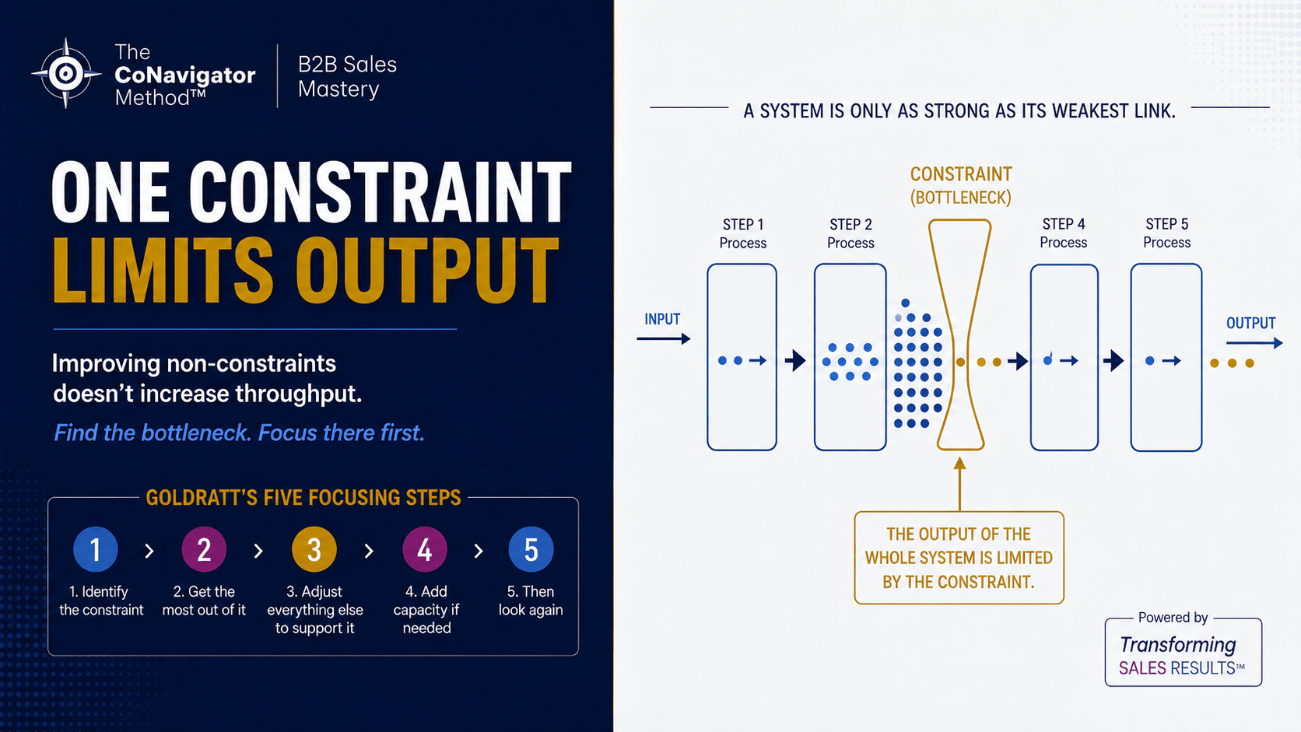
The book Ray read was The Goal, written by Eliyahu Goldratt with Jeff Cox in 1984. It’s a novel about a plant manager, and it’s where the Theory of Constraints entered general business thinking.
The premise takes one sentence.
In any flow that produces something, one step limits the output of the entire flow.
This might remind you of the old saying, “A chain is only as strong as its weakest link.” Basically the same idea. Two things follow from that:
- Time lost at the constraint is lost for the whole system and you don’t get it back.
- Time saved anywhere else doesn’t help, because the constraint still sets the pace.
Goldratt laid out five steps.
- Identify the constraint.
- Get the most out of it with what you already have.
- Adjust everything else to support it.
- Add capacity to it if you still need to.
- Then look again, because once you fix one, something else becomes the limiting step.
Step two deserves a note, because Goldratt’s word for it was “exploit,” which sounds worse than what he meant. He meant this: before you spend money on the constraint, make sure you’re getting everything you can out of it as it stands. Ray didn’t buy a second leak-test cell. He stopped wasting the capacity of the one he had. That’s step two, and it’s usually where the cheap wins live, or what some call the “low-hanging fruit.”
Most organizations skip it. Getting capacity approved is easier than exercising discipline.
Why Sales Doesn’t Get This Treatment
Walk a factory floor that isn’t 100% automated, and local efficiency is visible. You can see parts stacking up in front of the slow station. (If you’re around my age, you may now be thinking of a classic “I Love Lucy” episode with the conveyor belt.)
Nothing stacks up quite like that in a sales organization. What you get instead is a soft quarter and a familiar response: “Harder, faster, longer, louder!” It’s an age-old battle cry. More calls. More emails. More coverage in the pipeline. More hours. And today, perhaps, more agentic AI.
That’s an activity push, not an improvement. And it’s exactly what Goldratt described, which is running the non-constraint stations faster and wondering why output didn’t change.
I say something similar about sales technology and AI. If you don’t fix effectiveness first, all a tool does is help people do a lot more dumb things even faster. Same principle. You can add speed to a broken step and get nothing but more of what wasn’t working.
Focus on effectiveness first, then efficiency. Otherwise, you do a lot more dumb stuff even faster.
Meanwhile, the metrics all look defensible. Activity is up. Meetings booked are up. Training completion is at 94%. Sequence volume is climbing. Every one of those can improve while revenue sits still, because none of them is throughput. Throughput in a sales organization looks more like sales velocity: qualified opportunities, times average deal size, times win rate percentage, divided by sales cycle time.
Sales Usually Has Three “Lines,” Not One

Here’s where the manufacturing comparison needs adjusting.
A plant is one flow with one constraint. Many commercial organizations have three, and they produce different things:
- Pipeline creation (qualified appointments set and run).
- Opportunity conversion (closed-won opportunities and revenue).
- Account expansion (growth in the territory/install base).
Yes, depending on your sales model, this can vary. But I’ll use these three buckets, which I’ll call zones, as our example. Each has its own output. Each has its own set of things holding that output back.
So, there isn’t one constraint in a sales organization. There are constraints in each of the three, and the work happens on multiple levels.
- Identify the constraints in each zone.
- Determine which constraint is doing the most damage to each zone’s output.
- Decide which zone deserves your attention first.
Those three aren’t independent, either. Opportunity conversion is a continuation of pipeline creation, working the same deal further along. Account expansion inherits whatever happened in both. A deal that was qualified honestly and managed well through the buying process arrives at implementation positioned to deliver what the buyer expected. Good execution by Customer Success, or great service and low-friction quoting, ordering, and delivery in a more transactional relationship, keeps it there. A deal pushed through on optimism, with undeliverable promises made, arrives as somebody else’s problem.
Because of that, when two zones both need work, the one further to the left almost always needs it more. Fix conversion while pipeline creation is broken, and you’ve built a better way to work bad opportunities. When scores come back close to even across all three, work left to right. The exception is a genuine emergency, and those are rarer than they feel.
One definition before we get into it. A constraint here is the ineffective thinking, action, or lack of action that’s reducing effectiveness.
- Sometimes that’s something nobody’s doing.
- Sometimes it’s something being done poorly.
- Sometimes it’s a practice that actively works against the outcome you want.
All three shapes show up below.
Pipeline Creation
What leadership sees: outreach goes out and little comes back. Response rates are low. The meetings that do get booked are with people who can’t act. The pipeline that forms is thin, late, or full of deals that were never real.
Common constraints:
- Outreach leads with what you sell instead of a problem the prospect recognizes, so nothing in it feels relevant and it gets deleted along with everything else that showed up that morning.
- Nobody has defined the ideal customer profile clearly enough to tell a good-fit account from a merely available one, so effort spreads evenly across prospects who were never going to buy. Spaghetti, meet wall.
- Research is skipped, or done at the same depth for a strategic target and a transactional one.
- Everything goes through one channel, usually email, so the only prospects reached are the ones who read email from strangers.
- Sellers stop after two touches and mark the prospect uninterested. The prospect was busy.
- Buyers who aren’t ready yet get dropped instead of nurtured, so the pipeline only holds people who happened to be in-market the week someone called.
Francine spent her first few years at Nuvanta living in that first bullet. She worked hard and followed the playbook she’d been given, and her outreach opened with some version of “Nuvanta is a leader in HEPA filtration.” Facilities directors weren’t confused about who the message was for. They just had no reason to care. She hit quota about as often as she missed it.
What changed it wasn’t more activity. It was different activity.
Francine replaced the single generic value proposition with value stories, plural and specific, built with POSE: Problem, Outcome, Solution, Explore. She leads with a problem the buyer will recognize. To a hospital facilities director, that sounds like: “Many hospital networks we work with struggle to maintain air quality compliance because of aging HVAC systems. Is that something you’re wrestling with, too?” Then the Explore step, which is simply asking whether it makes sense to look into it further, rather than asking for a meeting. Smaller request. Better response rate.
She also stopped treating outreach as a single event. Every deal needs AIR to breathe (Awareness, Interest, and Relationship/Trust). Building AIR takes multiple touches across multiple channels: Awareness that she exists and why her experience is relevant, Interest in what she raised, and Relationship enough to be trusted with a real conversation. Buyers who aren’t ready yet go into a nurture cycle rather than into the trash (unless they opt out entirely).
Opportunity Conversion
What leadership sees: deals enter the pipeline and sit. Cycle times stretch. Forecasts slide right. And the most common outcome isn’t losing to a competitor; it’s no decision at all.
Common constraints:
- Everything that moves goes into the forecast, because pipeline coverage is the number managers inspect, so disqualifying a deal gets punished even when it’s the right call.
- Discovery stops at the first stated need and that becomes the whole diagnosis. Impact never gets quantified, so there’s no business case later and no urgency now.
- Nobody asked how the buyer actually buys, so procurement, legal, security review, and internal approvals show up as surprises in month four.
- Deals run through one contact. When that person goes quiet or changes roles, the deal goes with them.
- The same message goes to the CFO, the facilities manager, and the technical evaluator, who care about different things entirely.
- Meetings end with “I’ll send over some information” instead of an agreed next step, usually because the seller doesn’t want to hear the answer. (The antidote is HAM-BAM: Have a Meeting, Book a Meeting.) Time itself doesn’t really kill deals. The lack of momentum does.
- Concerns get treated as objections to overcome. The buyer pushes back, and the seller reads that as proof the buyer was never serious. (Or worse, gets defensive, or sees it as a wrestling match to win and keeps coming relentlessly.)
- Sales call planning happens in the parking lot, when it happens at all, and the objectives are the seller’s rather than anything the buyer would consider worth an hour.
In her training, Francine learned a name for how she used to walk out of those meetings. Hope Goggles. She’d pitched features, something seemed to land, and she left optimistic without being able to say what the buyer had actually committed to. When someone hesitated, she pushed. Her deals ran on her process, her goals, and her timeline.
Three things changed that.
She replaced the qualifying interrogation with a situation assessment built on COIN-OP: Challenges, Opportunities, Impacts, Needs, Outcomes, and Priorities. The goal is understanding the buyer’s current state, their desired future state, and what it takes to get from one to the other. Challenges on the left, outcomes on the right, and a dollarized business case in the middle that turns a nice-to-have into a must-have. Buyers can feel the difference in the first ten minutes.
She learned why deals actually stall. She used to assume price. It’s rarely price. Deals stall on Buying Process Exit Criteria, which is what each stakeholder needs to see, hear, understand, or believe before they’ll move to the next stage. The CFO’s criteria aren’t the facilities manager’s. Miss either one (especially for a key decision maker), and the deal stalls, however good the proposal is. Now Francine works four steps with each stakeholder: uncover the criteria, clarify them, satisfy them, and confirm she got it right. That last step is one question. “Does this address what you needed in order to feel confident moving forward?” It has restarted more stalled deals for her than any negotiation tactic she ever tried.
And she runs a check before she tries to influence anyone. Roughly 60% of buyers question a seller’s integrity, which makes trust a real differentiator in most competitive situations. NASA, or Need And Solution Alignment, is Francine confirming her solution actually fits and is actually in the buyer’s interest before she tries to influence or persuade. If it doesn’t fit, she doesn’t push. That’s the line between influence and manipulation, and it also happens to be good qualification.
Account Expansion
What leadership sees: the base is stable but flat. Renewals happen. Growth doesn’t. Nobody’s alarmed, because nothing looks broken, which is why this one can sit untouched for years.
Common constraints:
- Relationships never widen past the original buyer, so the account is one retirement or reorg away from being a cold call again.
- Account potential gets assessed unrealistically or not at all, so the account objective is a guess.
- Accounts land on touch-base status, where the rep delivers donuts and pleasantries instead of staying current on decision makers, priorities, and outcomes.
- Customer Value Reviews, or QBRs if that’s your term, either don’t happen or happen without a strategy. Results go unreported, problems go unsurfaced, new needs go undiscovered, and the relationship flattens.
- Nobody maps the account landscape the way they’d map a buyer landscape in a live deal, so shifting attitudes and new stakeholders go unnoticed until a competitor finds them first.
Francine used to run her account base on instinct and call it judgment. The accounts she enjoyed got attention. The rest got a quarterly check-in that was pleasant and accomplished nothing.
Now she assesses each account with PCF-L: Past performance, Current performance, Future potential, and Likelihood. That gives her the evidence to set one clear objective per account, chosen from A-G-R3: Acquire, Grow, Retain, Reactivate, or Retire.
With the objective set, she builds the plan using Force Field Analysis, identifying the driving forces (moving her toward the objective) that she can amplify and the restraining forces (keeping her from achieving the objective) that she needs to reduce or remove.
That last part should sound familiar. Everything listed in this article about constraints is a restraining force. Force Field Analysis is constraint thinking at the account level, which is a nice piece of symmetry and also a reason the two fit together so well in practice.
With the factors analyzed, you can weight them (to help prioritize), and ask two simple yet powerful questions:
- What can I do to reduce or eliminate the restraining forces?
- What can I do to add or strengthen the driving forces?
And suddenly, you have an account plan that is directly tied to achieving the account objective.
The Misdiagnosis Problem

The number that hurts is usually not where the constraint lives.
Win rates are visible and painful, so win rates get the investment, even when the real problem is that unqualified pipeline keeps arriving from upstream. Flat account growth is visible, so more accounts get added to the target list, when the actual problem is that nobody’s mapping the account landscape and having real, strategic conversations with the accounts already on the books.
That’s expensive in more than one way. You spend the budget, you don’t get the result, and you burn credibility with your boss, your peers, and even your own sales force. The next change you try to make is harder to sell internally, because the last one didn’t work.
Diagnose before you prescribe. It’s the same standard we’d expect of a seller with a buyer, and we need to hold ourselves to it.
Where the Comparison Stops
A plant is predictable in a way that buyers aren’t. People don’t move through your process on your schedule. With multiple decision makers, the process isn’t always linear. And your constraint is often human capability or the systems that support it, rather than a machine. All of which means getting more out of it looks like methodology adoption, workflow integration, coaching cadence, and manager reinforcement.
The constraint may also not be in any of the three zones.
- It might be in hiring, and you keep replacing people who were never going to succeed in the role.
- It might be in compensation, which may be paying for behavior you say you don’t want.
- It might be in frontline management, which is where I’d look first, because frontline managers are the highest-leverage investment in most organizations and the most commonly neglected.
- It might be the product or the market, and no amount of seller capability fixes either one.
Pipeline creation, opportunity conversion, and account expansion cover constraints in seller capability and execution. That’s a big category and it’s where a lot of revenue problems live. It isn’t every category, though. A strong situation assessment should be able to tell you when the answer is somewhere else.
What Nuvanta Did
Dana started where I’d suggest most sales leaders start, by looking at a single focused effort aimed at whichever zone was doing the most damage.
Then the diagnostic results came in and our joint situation assessment deepened them. Scores were soft across all three zones, and the connections between them were visible in the data we reviewed. Weak pipeline creation was feeding conversion problems. Conversion problems were leaving a lot of revenue on the table. And an unstructured approach to strategic and key account management was not maximizing account base growth potential.
Here’s the interesting thing, though. Nuvanta was performing “acceptably.” There was no big fire to put out. For better or worse, the real issue turned out to be a lot of missed potential for radical growth that was invisible until you went looking for it. This meant Dana had something a lot of CROs don’t have: breathing room. The business was doing “good enough,” the board wasn’t leaning on her, and the CEO wasn’t asking for quarterly miracles. So, to her credit, she took the long view and implemented the full methodology across the commercial organization, working through it in the same order as the three zones above. In essence, doing successive sprints, with no gaps in between.
- Sidebar: That was the right call for Nuvanta. It isn’t automatically the right call for you. If you’re under real pressure to show results in one or two quarters, a focused effort aimed at your biggest constraints will get you there faster and let you prove the value before you commit to more. If your assessment points to one clear problem area, fixing that one may be all you need. Nuvanta’s results were not unheard of, but they weren’t common either. They pointed one direction. Yours may point somewhere else, and the whole concept here is that you should find out before you decide.
The overall lift for Nuvanta over the next six to nine months was significant. The more interesting outcome was Francine.
She’d been solidly average for years. Reliable, well-liked, middle of the pack. She threw herself into the methodology in a way most of her peers didn’t, practiced relentlessly, and had her sales manager, Jeff, coaching her through it instead of just announcing the rollout and moving on. Six months later she was one of their top salespeople and had been promoted to Senior AE. A year after that she’s still in the field as their number one performer, producing at an elite level, and has entered the company’s management development program (to prepare her prior to her promotion—something else Nuvanta does well).
Francine’s transformation wasn’t magic. The speed of it was unusual, though, and she earned it with hard and smart work. What she learned is a repeatable set of practices—things to continue, start, and stop doing, based on what the very best salespeople do (the top 1–4%). Your top performers are already good, but everyone can get better. The bottom performers often shouldn’t be there, but deserve a chance if they’re trying. The biggest possible gains sit with capable people in the middle who were never given a system and support to get to high levels of adoption and mastery. You’ve probably heard the phrase, “Move the middle,” and that’s what this will help you do.
Diagnose First, Then Prescribe

If you take one thing from Goldratt into your commercial organization, take the sequence. Find the biggest constraint in each zone. Get everything you can out of what you already have before you spend. Adjust the rest to support it. Add capacity only if you have to. Then look again, because something else will be limiting you now. Run the gauntlet.
That’s the thinking behind Revenue Acceleration Sprints. Three focused 90-day engagements, one for each zone, built to fix what’s blocking you before adding anything new. But those are the prescription, and the prescription comes second.
The diagnostic comes first. If you’re intrigued, I have one. Discussion may be needed afterward, but it is a great start. It’s complimentary, takes about ten minutes, and will tell you where you actually stand. I recommend a follow-up situation assessment, but let’s take one step at a time.
- Click Revenue Acceleration Sprints (ungated) to download more information.
- Click Sales Effectiveness Diagnostic to take the assessment and see your biggest constraint.
Closing Thoughts
Ray Delgado spent two years making his plant better one station at a time, and got nothing for it until he found the step that was truly limiting the output. He didn’t need new equipment. He needed to know where to look.
Sales is usually harder than that, because there are often three “lines” running rather than one, and the constraints are in how people think and act rather than in a machine. But the discipline transfers cleanly. Find what’s blocking each zone, prioritize based on impact, and fix the biggest one first. Then look again.
The alternative is yelling “Harder, faster, longer, louder!” That’s not a strategy. It’s just noise with a quota.
So, a question to ponder. If you asked your sales leadership team to name the single biggest thing blocking revenue right now, and to show you the evidence behind it, would you get one answer or five?
If it’s five, you don’t have a revenue problem yet. You have a diagnosis problem, and that’s the one to fix first.
Resources
- Take the Sales Effectiveness Diagnostic
- Read Your Sales Methodology Execution Gap Is Costing You Millions
- Read B2B Sales Methodology Differentiators: How Does Your Approach Compare to Top Performers?
- Read You Can’t Improve Revenue by Focusing on Revenue!
- Read The Goal by Eliyahu M. Goldratt and Jeff Cox
How to Follow My Work, Connect, or Work With Me
- Revenue Acceleration Sprints: Revenue Acceleration Sprints (ungated PDF download)
- The Building Blocks of Sales Enablement Book: https://bit.ly/BBofSE
- My Sales Enablement Straight Talk Newsletter: Sales Enablement Straight Talk! (Subscribe!)
- My LinkedIn Profile: https://www.linkedin.com/in/mikekunkle
- My Linktree: https://linktr.ee/mikekunkle
- Get in Touch: https://conavigatormethod.com/contact/
About Mike
Mike Kunkle is an internationally recognized expert on sales training, sales effectiveness, and sales enablement. He’s spent over 30 years helping companies drive dramatic revenue growth through best-in-class enablement strategies and proven-effective sales systems—and he’s delivered impressive results for both employers and clients. Mike is the founder of Transforming Sales Results, LLC, where he does research and publishes thought leadership, designs sales training, delivers workshops, and helps clients improve sales results through a variety of sales effectiveness practices, sales systems, and advisory services. His book, The Building Blocks of Sales Enablement, is available on Amazon, and The CoNavigator Method for B2B Sales Mastery will be published in 2026.
Discover more from MikeKunkle.com
Subscribe to get the latest posts sent to your email.
